1

The useful trees of northern Nigeria — Inside the Classic
(0 User reviews)
67
Project Gutenberg
2023
Not confirmed
Plants, Useful -- Nigeria, Northern; Trees -- Nigeria, Northern
Readers of public-domain and historical texts
Project Gutenberg digital edition
en
Edition facts
Words
60,330
Reading time
263 min
Text sections
11
This digital edition of The useful trees of northern Nigeria — Inside the Classic is described by source-level measurements including 60,330 words, 4 hr 23 min estimated reading time, and 11 detected text sections.
The text analysis averages about 17.1 words per sentence, while the detected sections provide another way to judge how the source is divided.
Project Gutenberg metadata also associates the work with “Plants, Useful -- Nigeria, Northern,” connecting these edition facts with the source record’s subject description.
Source:
Project Gutenberg record #72006
H. V. Lely's 1925 field guide to 120 savannah trees of Northern Nigeria, with uniform descriptions of bark, wood, leaves, flowers, and fruits, plus original drawings. The preface explains the alphabetical arrangement and the practical identification focus, while entries like those for Baobab and Gardenia species show precise botanical detail and local uses.
Editorial Edition Score
4.8/5
★★★★★
★★★★★
Calculated from edition completeness, EPUB availability, text structure and catalogue metadata. Not a user rating.
How this score is calculated
- Description quality20 pts
- Title & short description10 pts
- Source metadata20 pts
- Text length15 pts
- Chapters / structure15 pts
- EPUB file integrity20 pts
Total of 100 points, scaled to a 2.5-5.0 range. Editions with an empty description or a missing EPUB file are not scored.
Edition quality
Read the Text
THE USEFUL TREES OF NORTHERN NIGERIA
BY H. V. LELY _Assistant Conservator of Forests_
Published by the Crown Agents for the Colonies, 4, Millbank, London, S.W. 1. 1925.
DESCRIPTIONS OF SPECIES IN ALPHABETICAL ORDER 1
APPENDIX I.—TABLE OF FLOWERING SEASONS 121
APPENDIX II.—LIST OF SPECIES ARRANGED IN FAMILIES 126
INDEX OF NATIVE NAMES 127
The text and plates of this volume have been prepared with the primary object of identification of the trees of the savannah forests of Northern Nigeria. The volume is, in no sense, a Flora, and no attempt has been made to include all the species found in the region under survey. Trees, being distributed over a large number of Families of the plant kingdom, are a small proportion of the total number of flowering plants, and their systematic arrangement would not, except in a few cases, be an aid to identification. Some 30 Families are represented by the 120 species included, in one of which there are as many as 36 species. The botanical names are arranged, therefore, in their alphabetical order so as to group certain genera and species whose similarity aids identification and to make the volume, in its index form, handier for reference.
The text is arranged in paragraphs, the first giving a general description of the form, height, girth, habitat, locality, &c., successive paragraphs describing in detail the bark and slash, thorns, wood, leaves, flowers, fruits and seeds, with a few notes on uses where these are known. These paragraphs are in uniform order for rapid reference.
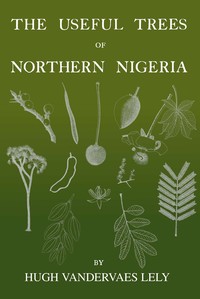
The text is supplemented by drawings of the flower, leaf, thorn, fruit and seed, sketched from the living specimens. Wherever possible the drawings are actual size to avoid calculations from enlarged or reduced figures, but a number have been enlarged to show structures, or reduced owing to their actual size. In several cases sections of various parts have been made to illustrate peculiarities of structure, a pocket lens being used for this purpose, though practically all the parts drawn are visible to the unaided eye.
The majority of the botanical names have been verified through the Herbarium of the Royal Botanic Gardens at Kew.
In describing the woods, few of which are in use and many of which are little likely to be of use, an attempt has been made to strike a path midway between the complete technical and botanical description employed with regard to timbers and a vague statement as to colour, quality, hardness and grain which helps little to distinguish the individual from others like it. Most of the woods are described from samples collected by the author and shaped by the Sokoto Arts and Crafts School. I am indebted for these, and for the facilities offered for observing their behaviour under tools, to Mr. W.E. Nicholson. The dry weight of seasoned wood is given in all cases and in this connection it may be noted that a number of species produce heavier wood in the north than they do in the south.
A table of flowering seasons has been appended, with a few notes on its significance.
A second appendix arranges the 120 species under their Families. The _Genera Plantarum_ of Bentham and Hooker has been followed.
Finally, there is an index of _Hausa_ names for reference to the plates and text, whose numbers are given in the index. A blank column has been left in the index for the benefit of those who may desire to collect either additional _Hausa_ names or the nomenclature of other tribes. It is hoped that the scope of the volume will be enlarged thereby, so as to cover other parts of Nigeria where the trees are the same but the language different.
The botanical name, being universal, is always given preference. The native names, variable and unreliable as they often are, should be a secondary consideration, their importance resting in their being a means of communication with the native rather than a short cut to the botanical names. In a country where there are several native names for one tree or one native name for several distinct species, the knowledge gained is either limited to a small number of trees or applicable to a small area of country. But once examined and properly identified, no number of native names need confuse the real identity. In collecting native names a warning should be given against the ignorant or ready-to-please native, and independent corroboration is advisable before accepting a name as worth recording. At the same time it is a fact that names genuinely differ in quite small areas of country where the same language is spoken, and a knowledge of the botanical names or real familiarity with the tree species is essential to reliable work.
H. V. Lely's The Useful Trees of Northern Nigeria (1925) is a field guide built for rapid identification, not a comprehensive flora. The preface states that the 120 species are arranged alphabetically, grouping similar genera to aid comparison, and that each entry follows a fixed paragraph order: general form, then bark, wood, leaves, flowers, fruits, seeds, and uses. This uniform structure lets a reader quickly locate specific details across species.
The text is supplemented by drawings of flower, leaf, thorn, fruit, and seed, sketched from living specimens and mostly actual size. Lely notes that a pocket lens was used to examine structures, but nearly all parts drawn are visible to the unaided eye. The work thus balances technical accuracy with practical accessibility for foresters and travellers in the savannah.
Alphabetical Order as a Finding Aid
Lely explains that because trees belong to many plant families, a systematic arrangement would not help identification. Instead, he lists species alphabetically by botanical name, so that similar genera—like Gardenia erubescens and Gardenia ternifolia—appear side by side. This allows direct comparison of their distinguishing features. For example, the entry for G. erubescens notes that it has larger, paler leaves, crisp fruits, and a more shrub-like growth than G. ternifolia, which can reach 20 feet and has a flat-topped crown. The alphabetical index of native names at the back further aids local users.
Uniform Paragraphs for Quick Reference
Each species description follows the same sequence: first a general description of form, height, girth, habitat, and locality; then paragraphs on bark and slash, thorns, wood, leaves, flowers, fruits, seeds, and uses. This consistency lets a reader compare, say, the bark of the Baobab—'light grey with large polygonal scales'—with that of Gardenia erubescens, which is 'smooth, grey-brown, with a powdery surface'. The wood descriptions are deliberately midway between technical jargon and vague colour statements: Lely gives weight per cubic foot, grain, and transverse section details, as when he notes that G. erubescens wood 'planes well, seasons well, is sound and clean and weighs 50 lbs. a cubic foot'.
Botanical Precision in the Field
The entries show careful observation of living specimens. For the Baobab, Lely records that leaves average 6 inches by 5 inches but can exceed that by 2 inches, with a slightly cordate base and broadly waved margin. The figs are 'almost up to 2 inches in diameter, flattened or pear-shaped, with a slight, softly hairy coat'. For Gardenia erubescens, he describes the flower in detail: 'large, white, tubular, 6-petalled blooms, 3 inches in diameter with a very long, narrow corolla tube from which protrudes a ribbed club-like stigma'. He also notes local uses—the fruits are eaten fresh or made into soup, and the whole plant is cut for fencing farms. Such details ground the guide in practical knowledge.
Lely's guide is best used as a companion in the field, where its alphabetical arrangement and uniform paragraphs allow quick cross-referencing. The drawings, mostly actual size, help confirm identifications without needing a ruler. Readers should note that the text covers only 120 of the many savannah species, and that Lely explicitly states it is not a complete flora. The work remains a focused tool for those who need to name and understand the useful trees of Northern Nigeria.
Lely’s careful entries on baobab and gardenia remind me how much patience sits inside a good field guide. I found myself thinking of another quiet companion, Forest Trees of Illinois (Third Edition) — Reading Companion, which carries that same unhurried devotion to bark and leaf, though the forests themselves are a world away.
There are no reviews for this eBook.
There are no comments for this eBook.
Reader reflection
Your personal reading reflection
Build a private reading journal entry for this title.
Your progress
0
/
10
2
Did this book hold your interest?
3
How likely are you to recommend this book?
4
How much effort did this book require?
5
How valuable was this book for your own interests?
6
Was the book easy to understand?
7
Did any part of the book feel personally relevant?
8
Was the book what you thought it would be?
9
Which lesson or insight stayed with you?
10