1

Handbook of the Trees of New England — Themes and Context
(0 User reviews)
2863
Project Gutenberg
2007
Not confirmed
Trees -- New England; Trees -- North America
Readers of public-domain and historical texts
Project Gutenberg digital edition
en
Edition facts
Words
56,245
Reading time
245 min
Text sections
14
Before opening Handbook of the Trees of New England — Themes and Context, the edition data offers a quick orientation: 56,245 words, 4 hr 5 min estimated reading time, and 14 detected text sections.
The text analysis averages about 16.7 words per sentence, while the detected sections provide another way to judge how the source is divided.
Project Gutenberg metadata also associates the work with “Trees -- New England,” connecting these edition facts with the source record’s subject description.
Source:
Project Gutenberg record #20467
A field guide to New England trees, emphasizing regional variation and the meeting of Canadian and Alleghanian floras, with detailed descriptions of habitat, bark, buds, and fruit.
Editorial Edition Score
4.8/5
★★★★★
★★★★★
Calculated from edition completeness, EPUB availability, text structure and catalogue metadata. Not a user rating.
How this score is calculated
- Description quality20 pts
- Title & short description10 pts
- Source metadata20 pts
- Text length15 pts
- Chapters / structure15 pts
- EPUB file integrity20 pts
Total of 100 points, scaled to a 2.5-5.0 range. Editions with an empty description or a missing EPUB file are not scored.
Edition quality
Read the Text
Produced by Juliet Sutherland, Janet Blenkinship, Joyce Wilson and the Online Distributed Proofreading Team at http://www.pgdp.net
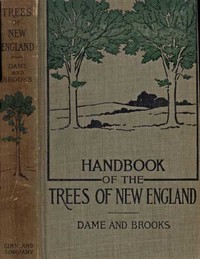
HANDBOOK OF THE TREES OF NEW ENGLAND
_WITH RANGES THROUGHOUT THE UNITED STATES AND CANADA_
BY LORIN L. DAME, S.D. AND HENRY BROOKS
_PLATES FROM ORIGINAL DRAWINGS_ BY ELIZABETH GLEASON BIGELOW
BOSTON, U.S.A. GINN & COMPANY, PUBLISHERS The Athenæum Press 1904
COPYRIGHT, 1901, BY LORIN L. DAME AND HENRY BROOKS
There is no lack of good manuals of botany in this country. There still seems place for an adequately illustrated book of convenient size for field use. The larger manuals, moreover, cover extensive regions and sometimes fail by reason of their universality to give a definite idea of plants as they grow within more limited areas. New England marks a meeting place of the Canadian and Alleghanian floras. Many southern plants, long after they have abandoned more elevated situations northward, continue to advance up the valleys of the Connecticut and Merrimac rivers, in which they ultimately disappear entirely or else reappear in the valley of the St. Lawrence; while many northern plants pushing southward maintain a more or less precarious existence upon the mountain summits or in the cold swamps of New England, and sometimes follow along the mountain ridges to the middle or southern states. In addition to these two floras, some southwestern and western species have invaded Vermont along the Champlain valley, and thrown out pickets still farther eastward.
At or near the limit of a species, the size and habit of plants undergo great change; in the case of trees, to which this book is restricted, often very noticeable. There is no fixed, absolute dividing line between trees and shrubs. In accordance with the usual definition, a tree must have a single trunk, unbranched at or near the base, and must be at least fifteen feet in height.
Trees that are native in New England, or native in other sections of the United States and thoroughly established in New England, are described and, for the most part, figured. Foreign trees, though locally established, are not figured. Trees may be occasionally spontaneous over a large area without really forming a constituent part of the flora. Even the apple and pear, when originating spontaneously and growing without cultivation, quickly become degenerate and show little tendency to possess themselves of the soil at the expense of the native growths. Gleditsia, for example, while clearly locally established, has with some hesitation been accorded pictorial representation.
The geographical distribution is treated under three heads: Canada and Alaska; New England; south of New England and westward. With regard to the distribution outside of New England, the standard authorities have been followed. An effort extending through several years has been made to give the distribution as definitely as possible in each of the New England states, and while previous publications have been freely consulted, the present work rests mainly upon the observations of living botanists.
All descriptions are based upon the habit of trees as they appear in New England, unless special mention is made to the contrary. The descriptions are designed to apply to trees as they grow in open land, with full space for the development of their characteristics under favorable conditions. In forest trees there is much greater uniformity; the trunks are more slender, taller, often unbranched to a considerable height, and the heads are much smaller.
When the trunk tapers uniformly from the ground upward, the given diameter is taken at the base; when the trunk is reinforced at the base, the measurements are made above the swell of the roots; when reinforced at the ground and also at the branching point, as often in the American elm, the measurements are made at the smallest place between the swell of the roots and of the branches.
A regular order has been followed in the description for the purpose of ready comparison. No explanation of the headings used seems necessary, except to state that the _habitat_ is used in the more customary present acceptation to indicate the place where a plant naturally grows, as in swamps or upon dry hillsides. Under the head of "Horticultural Value," the requisite information is given for an intelligent choice of trees for ornamental purposes.
The order and names of families follow, in the main, Engler and Prantl. In accordance with the general tendency of New England botanists to conform to the best usage until an authoritative agreement has been reached with regard to nomenclature by an international congress, the Berlin rule has been followed for genera, and priority under the genus for species. Other names in use at the present day are given as synonyms and included in the index.
The preface of this 1904 handbook immediately establishes a distinctive regional focus: New England is described as a meeting place of Canadian and Alleghanian floras, where northern and southern species intermingle along river valleys and mountain ridges. The authors note that at the limits of a species’ range, trees undergo noticeable changes in size and habit—a principle that informs the entire work.
Rather than attempting to cover the entire continent, the book restricts itself to trees native to New England or thoroughly established there, and it explicitly excludes foreign trees that are only locally spontaneous. This deliberate narrowing gives the handbook a practical, field-oriented character, reinforced by its compact size and original drawings by Elizabeth Gleason Bigelow.
Structure and Scope
The handbook is organized by plant families, from the Pine Family (Pinoideæ) through the Honeysuckle Family (Caprifoliaceæ), with a key to the trees of New England, a glossary, and an index. Each species entry follows a consistent pattern: habitat and range, habit, bark, winter buds and leaves, flowers, fruit, and horticultural value. The range descriptions are notably precise, often listing specific river valleys or Canadian provinces. For example, the American elm is said to thrive in the rich alluvium of the Connecticut River valley, while the scrub oak is noted for dry, gravelly, or sandy soil where few other trees thrive. The authors also distinguish between native trees and those merely “occasionally spontaneous,” a careful taxonomic stance that avoids inflating the flora.
Attention to Variation
A striking feature of the handbook is its detailed treatment of individual variation within species. The entry for the American elm describes five named forms—vase-shaped, umbrella, plume, drooping, and oak—each with distinct branching patterns and silhouettes. The authors observe that “short, irregular, pendent branchlets are occasional along the trunks” and that trees most noticeably feathered are usually of medium size. Similarly, the scrub oak entry notes that its acorn varies greatly in shape, “mostly ovoid or spherical, brown, often striped lengthwise.” This attention to morphological range reflects the authors’ field experience and their awareness that trees do not conform to a single ideal type.
Practical Observations and Limitations
The horticultural value notes are among the most concrete and useful sections. For the scrub oak, the authors state it is “not procurable in quantity from nurseries” and must be grown from seed, and they note that caterpillars may strip the leaves but that the tree is otherwise not seriously affected by insects or disease. The American elm is described as “conspicuous at all seasons,” with a detailed account of its appearance in spring, summer, autumn, and winter. However, the excerpts do not include complete entries for every species, and the reader should not assume that all trees receive equal depth of treatment. The handbook’s reliance on botanical authorities and abbreviations suggests a technical audience, though the prose remains accessible.
Readers using this handbook will benefit from paying close attention to the range descriptions and the notes on variation, as these reveal the authors’ nuanced understanding of how trees adapt to local conditions. The book is best used in the field, where its compact size and detailed plates can aid identification. Because the excerpts are partial, the full work may contain additional species or families not represented here, but the consistent structure makes it easy to navigate.
There’s a particular stillness in learning to read a birch by its bark alone, a patience this handbook taught me—the quiet meeting of northern and southern woods. That same unhurried recognition lives in Getting Acquainted with the Trees — Key Ideas to Explore, though it feels more like sitting on a stump, simply letting the trees introduce themselves. A gentler sort of knowing, perhaps.
There are no reviews for this eBook.
There are no comments for this eBook.
Reader reflection
How will you remember this book?
Save your reaction, strongest insight, and memorable passage.
Your progress
0
/
10
2
What was your overall reaction to the book?
3
Would you pass this book on to a friend?
4
How much effort did this book require?
5
Would a second reading be valuable?
6
Which aspect of the book did you value most?
7
Did the story or argument move comfortably?
8
Did you gain anything practical from the text?
9
Which lesson or insight stayed with you?
10