1

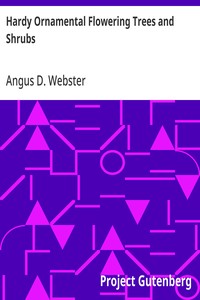
Hardy Ornamental Flowering Trees and Shrubs — Key Ideas to Explore
(0 User reviews)
70
Project Gutenberg
2004
Not confirmed
Flowering trees; Flowering shrubs
Readers of public-domain and historical texts
Project Gutenberg digital edition
en
Edition facts
Words
55,818
Reading time
243 min
Text sections
6
The source record for Hardy Ornamental Flowering Trees and Shrubs — Key Ideas to Explore measures this digital text at 55,818 words, 4 hr 3 min estimated reading time, and 6 detected text sections.
The text analysis averages about 16.5 words per sentence, while the detected sections provide another way to judge how the source is divided.
Project Gutenberg metadata also associates the work with “Flowering trees,” connecting these edition facts with the source record’s subject description.
Source:
Project Gutenberg record #10852
Webster's 1893 guide to over 1300 hardy flowering trees and shrubs, emphasizing lesser-known species for British gardens. The preface critiques monotonous planting of elm, lime, and oak, advocating for diverse ornamentals. Entries include botanical names, synonyms, introduction dates, native countries, and cultivation notes, with a focus on hardiness and ornamental value.
Editorial Edition Score
4.7/5
★★★★★
★★★★★
Calculated from edition completeness, EPUB availability, text structure and catalogue metadata. Not a user rating.
How this score is calculated
- Description quality20 pts
- Title & short description10 pts
- Source metadata20 pts
- Text length15 pts
- Chapters / structure15 pts
- EPUB file integrity20 pts
Total of 100 points, scaled to a 2.5-5.0 range. Editions with an empty description or a missing EPUB file are not scored.
Edition quality
Read the Text
HARDY ORNAMENTAL FLOWERING TREES AND SHRUBS.
_Author of "Practical Forestry," "Hardy Coniferous Trees," "British Orchids," &c., &c._
PREFACE TO FIRST EDITION, 1893.
This book has been written and is published with the distinct object in view of bringing home to the minds of planters of Hardy Trees and Shrubs, the fact that the monotonous repetition, in at least nine-tenths of our Parks and Gardens, of such Trees as the Elm, the Lime, and the Oak, and such Shrubs as the Cherry Laurel and the Privet, is neither necessary nor desirable. There is quite a host of choice and beautiful flowering species, which, though at present not generally known are yet perfectly hardy, of the simplest culture, and equally well adapted for the ornamentation of our Public and Private Parks and Gardens.
Of late years, with the marked decline in the cultivation of Coniferous Trees, many of which are ill adapted for the climate of this country, the interest in our lovely flowering Trees and Shrubs has been greatly revived. This fact has been well exemplified in the numerous enquiries after these subjects, and the space devoted to their description and modes of cultivation in the Horticultural Press.
In the hope, too, of helping to establish a much-desired standard of nomenclature, I have followed the generic names adopted by the authors of _The Genera Plantarum_, and the specific names and orthography, as far as I have been able, of the _Index Kewensis_; and where possible I have given the synonyms, the date of introduction, and the native country. The alphabetical arrangement that has been adopted, both with regard to the genera and species, it is hoped, will greatly facilitate the work of reference to its pages. The descriptive notes and hints on cultivation, the selected lists of Trees and Shrubs for various special purposes, and the calendarial list which indicates the flowering season of the different species, may be considered all the more valuable for being concisely written, and made readily accessible by means of the Index.
No work written on a similar plan and treating solely of Hardy Ornamental Flowering Trees and Shrubs has hitherto been published; and it is not supposed for a moment that the present one will entirely supply the deficiency; but should it meet with any measure of public approval, it may be the means of paving the way towards the publication of a more elaborate work--and one altogether more worthy of the interesting and beautiful Flowering Trees and Shrubs that have been found suitable for planting in the climate of the British Isles.
Of the fully thirteen hundred species and varieties of Trees and Shrubs enumerated, all may be depended upon as being hardy in some part of the country. Several of them, and particularly those introduced from China and Japan, have not before been included in a book of this character. Trials for the special purpose of testing the hardiness of the more tender kinds have been instituted and carried out in several favoured parts of England and Ireland.
A.D.W. HOLLYDALE, WOBURN.
PREFACE TO SECOND AND CHEAP EDITION, 1897.
The First Edition of Hardy Ornamental Flowering Trees and Shrubs having been sold out, it has been considered desirable to run off a second and cheap edition on exactly similar lines to the first, and previous to the more elaborate illustrated edition which is now in hand.
A.D.W. BOXMOOR, HERTS, 1897.
HARDY ORNAMENTAL FLOWERING TREES & SHRUBS.
ABELIA CHINENSIS (_syn A. rupestris_).--The Rock Abelia China, 1844. This is a neat, twiggy shrub, growing from 2 ft. to 3 ft. high, with slender shoots, and very pleasing, shining green serrated leaves. The tubular, sweet-scented flowers are produced in clusters at the ends of the shoots, even the smallest, and are of a very delicate shade of pink--indeed, almost white. It makes an excellent wall plant, but by no means refuses to grow and flower freely without either shelter or protection, provided a fairly rich and well drained soil is provided. From August to October is the flowering period of this handsome deciduous shrub. This is the only really hardy species of the genus, for though the rosy-purple flowered A. floribunda from Mexico has stood for several years uninjured in the South of England, it is not to be relied upon. Both species are readily propagated from cuttings.
A. TRIFLORA.--Himalayan regions, 1847. A half-hardy and beautiful species with small lanceolate, entire leaves, and pretty star-shaped flowers that are white and flushed with pink. The long, narrow, and hairy calyx-lobes give a light and feathery appearance to the flowers, which are produced continuously from May to November. It does best as a wall plant, and several beautiful examples may be seen in and around London, as also at Exeter, and in the South of Ireland.
Webster opens his 1893 preface with a pointed critique: the 'monotonous repetition' of elm, lime, oak, cherry laurel, and privet in nine-tenths of British parks and gardens is 'neither necessary nor desirable.' He positions his work as a corrective, aiming to introduce planters to a 'host of choice and beautiful flowering species' that are hardy, easy to cultivate, and underused. The book enumerates over 1,300 species and varieties, all claimed to be hardy in some part of the country. Webster follows the nomenclature of The Genera Plantarum and Index Kewensis, providing synonyms, introduction dates, and native countries for each entry. The alphabetical arrangement, he notes, is designed for quick reference.
A Practical Nomenclatural Standard
Webster explicitly states his hope to 'help establish a much-desired standard of nomenclature.' He adopts generic names from The Genera Plantarum and specific names from Index Kewensis, and includes synonyms where possible. This scholarly apparatus is unusual for a practical gardening manual of the period. For example, the entry for Myrtus Luma gives the synonym Eugenia apiculata and E. Luma, while Myrtus Ugni is cross-referenced as Eugenia Ugni. Similarly, Neillia opulifolia is noted as synonymous with Spiraea opulifolia. The inclusion of introduction dates (e.g., 'Canada, 1699' for Myrica cerifera) and native countries (e.g., 'Chili' for Myrtus Luma) adds historical and geographical context, though Webster does not explain how these dates were verified.
Hardiness and Cultivation Caveats
Despite the title's emphasis on 'hardy' plants, many entries carry significant caveats about survival. Myrtus communis 'cannot survive our winters' except in 'very favoured spots and by the sea-side,' and even then only as a wall plant. Myrtus Ugni is 'only hardy in favoured parts of the country' and 'wants the protection of a wall.' Nesaea salicifolia is 'half hardy,' requiring wall protection. Webster is candid about limitations: Myrtus Luma is 'not to be recommended for general planting, it being best suited for greenhouse culture.' These qualifications suggest that the book's definition of 'hardy' is relative, often meaning 'can survive in some British microclimates with protection.' The entries for Myrica species, however, are praised for adaptability to 'poor soil or swampy hollows,' showing Webster's attention to site-specific suitability.
Descriptive Detail Beyond Flowers
While the catalog subjects are 'Flowering trees' and 'Flowering shrubs,' Webster frequently describes plants whose flowers are 'inconspicuous.' Myrica cerifera has 'inconspicuous catkins'; Myrica Gale is included 'on account of the deliciously fragrant foliage,' not its flowers. The entry for Myrica species notes that 'the flowers are inconspicuous—their neat and in most cases fragrant foliage, and adaptability to poor soil or swampy hollows, being extra recommendations.' Similarly, Neillia opulifolia is valued for its 'curious swollen membraneous purplish fruit' after flowering. Neviusa alabamensis has flowers that are 'white or yellowish-green, with prominent stamens of a tufted brush-like character.' Webster's descriptions often emphasize foliage, fruit, and overall habit, not just blooms, broadening the book's appeal beyond purely floral ornament.
Webster's book is best approached as a period reference work with a specific reformist agenda. Readers should note that the hardiness claims are calibrated to late-19th-century British conditions and may not apply elsewhere or under current climate shifts. The alphabetical arrangement and concise entries make it useful for quick consultation, but the preface's critique of common planting practices provides essential context for understanding Webster's selection criteria. The inclusion of non-flowering attributes—fragrant foliage, ornamental fruit, and adaptability—reveals a broader definition of 'ornamental' than the catalog subjects might suggest.
That rain kept drumming the conservatory glass while I turned through Webster’s pages, noting how he preferred the quiet hawthorns over the usual elms. The careful entries felt like someone’s patient handwriting. Later, my eye drifted to a shelf where a slimmer volume rested—Handbook of the Trees of New England — Themes and Context—and somehow the same afternoon light seemed to fall on both.
There are no reviews for this eBook.
There are no comments for this eBook.
Reader reflection
How did this book work for you?
Your answers remain private and are stored only in this browser.
Your progress
0
/
10
2
How did the book work for you overall?
3
Would you encourage someone else to read it?
4
How easy was the book to follow?
5
Would you read this book again?
6
Did the book give you something worth debating?
7
Which part made the strongest impression?
8
Did the story or argument move comfortably?
9
Which lesson or insight stayed with you?
10