1

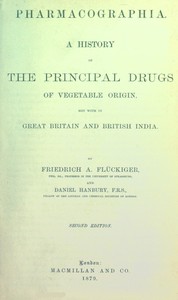
Pharmacographia A history of the principal drugs of vegetable origin, met with in Great Britain and British India — Key Ideas to Explore
(0 User reviews)
373
Project Gutenberg
2022
Not confirmed
Botany, Medical; Materia medica, Vegetable; Materia medica, Vegetable -- India; Materia medica, Vegetable -- Great Britain
Readers of public-domain and historical texts
Project Gutenberg digital edition
en
Edition facts
Words
409,361
Reading time
1780 min
Text sections
124
The catalog record for Pharmacographia A history of the principal drugs of vegetable origin, met with in Great Britain and British India — Key Ideas to Explore provides practical reading context through 409,361 words, 29 hr 40 min estimated reading time, and 124 detected text sections.
The text analysis averages about 16.7 words per sentence, while the detected sections provide another way to judge how the source is divided.
Project Gutenberg metadata also associates the work with “Botany, Medical,” connecting these edition facts with the source record’s subject description.
Source:
Project Gutenberg record #67691
A detailed botanical and historical study of principal vegetable drugs in 19th-century British and Indian pharmacopoeias, based on personal research and European, Indian, and American scholarship, excluding pharmacy and therapeutics.
Editorial Edition Score
4.9/5
★★★★★
★★★★★
Calculated from edition completeness, EPUB availability, text structure and catalogue metadata. Not a user rating.
How this score is calculated
- Description quality20 pts
- Title & short description10 pts
- Source metadata20 pts
- Text length15 pts
- Chapters / structure15 pts
- EPUB file integrity20 pts
Total of 100 points, scaled to a 2.5-5.0 range. Editions with an empty description or a missing EPUB file are not scored.
Edition quality
Read the Text
longitudinally. The bark is of a dark blackish brown or even quite black when free from earth, and disposed to exfoliate. The root breaks with a coarse fibrous fracture; the inner substance is of a light yellowish-brown,—sometimes of a dull greenish brown.
Roots of about an inch in diameter cut transversely exhibit a central column 0·2 to 0·4 of an inch in diameter composed of 10 to 20 converging wedges of large-pored woody tissue with 3 or 4 zones divided from each other by a wavy light-coloured line. Crossing these zones are wedge-shaped woody rays, often rather sparsely and irregularly distributed. The interradial substance has a close, resinous, waxy appearance.
[122] _Species Plantarum_, Holmiæ, 1753; see also _Mat. Med._ 1749. No. 459.
[123] Lunan, _Hort. Jamaic._ ii. (1814) 254; Descourtilz, _Flor. méd. des Antilles_, iii. (1827) 231.
[124] Thus it was omitted from the London pharmacopœias of 1809 and 1824, and from many editions of the _Edinburgh Dispensatory_.
[125] Hanbury in _Pharm. Journ._ Aug. 2-9, 1873, pp. 81 and 102.
[126] _Lond. Med. Gazette_, Feb. 16, 1828; Brodie, _Lectures on Diseases of the Urinary Organs_, ed. 3. 1842. 108, 138.
The root though hard is easily shaved with a knife, some pieces giving the impression when cut of a waxy, rather than of a woody and fibrous substance. The taste is bitter, well marked but not persistent. The drug has no particular odour. Its aqueous decoction is turned inky bluish-black by tincture of iodine.
The aerial stems especially differ by enclosing a small but well-defined pith.
=Microscopic Structure=—The most interesting character consists in the arrangement rather than in the peculiarity of the tissues composing this drug. The wavy light-coloured lines already mentioned are built up partly of sclerenchymatous cells. The other portions of the parenchyme are loaded with large starch granules, which are much less abundant in the stem.
=Chemical Composition=—From the examination of this drug made by one of us in 1869,[127] it was shown that the bitter principle is the same as that discovered in 1839 by Wiggers in the drug hereafter described as _Common False Pareira Brava_, and named by him _Pelosine_. It was further pointed out that this body possesses the chemical properties of the _Bibirine_ of Greenheart bark and of the _Buxine_ obtained by Walz from the bark of _Buxus sempervirens_ L. It was also obtained on the same occasion (1869) from the stems and roots of _Cissampelos Pareira_ L. collected in Jamaica; but from both drugs in the very small proportion of about ½ per cent.
Whether to _Buxine_ (for by this name rather than _Pelosine_ it should be designated) is due the medicinal power of the drug may well be doubted. No further chemical examination of true Pareira Brava has been made.
=Uses=—The medicine is prescribed in chronic catarrhal affections of the bladder and in calculus. From its extensive use in Brazil[128] it seems deserving of trial in other complaints. Helvetius used to give it in substance, which in 5-grain doses was taken in infusion made with boiling water from the powdered root and not strained.
=Substitutes=—We have already pointed out how the name _Pareira Brava_ has been applied to several other drugs than that described in the foregoing pages. We shall now briefly notice the more important.
1. _Stems and roots of Cissampelos Pareira_ L.—Owing to the difficulty of obtaining good Pareira Brava in the London market, although this plant is very widely diffused over all the tropical regions of both hemispheres, the firm of which one of us was formerly a member (Messrs. Allen and Hanburys, Plough Court, Lombard Street) caused to be collected in Jamaica, under the superintendence of Mr. N. Wilson, of the Bath Botanical Gardens, the stems and root of _Cissampelos Pareira_ L., of which it imported in 1866-67-68 about 300 lb. It was found impracticable to obtain the root _per se_; and the greater bulk of the drug consisted of long cylindrical stems,[129] many of which had been decumbent and had thrown out rootlets at the joints. They had very much the aspect of the climbing stems of _Clematis vitalba_ L., and varied from the thickness of a quill to that of the forefinger, seldom attaining the diameter of an inch. The stems have a light brown bark marked longitudinally with shallow furrows and wrinkles, which sometimes take a spiral direction. Knots one to three feet apart, sometimes throwing out a branch, also occur. The root is rather darker in colour, but not very different in structure from the stem.
[127] _Neues Jahrb. f. Pharm._ xxxi. (1869) 257; _Pharm. Journ._ xi. (1870) 192.
[128] “Presentamente (Abutua) é reputada diaphoretica, diuretica e emenagoga, e usada interiormente na dóse de duas a quatro oitavas para uma libra de infusão ou cozimento, nas febres intermittentes, hydropisias, e suspensão de lochios.”—Langgaard, _Diccionario de Medicina domestica e popular_, Rio de Janeiro, i. (1865) 17.
[129] Figured, together with the plant, in Bentley and Trimen, _Medic. Plants_, part 9 (1876).
The authors deliberately coin the term Pharmacographia to signal a work focused on writing about drugs rather than a comprehensive dispensatory. They restrict their scope to botanical origin, history, description, microscopic structure, and chemical composition, explicitly excluding pharmacy and therapeutics. The preface states the book is a record of personal researches, not a compilation of others' findings.
The excerpts show a consistent structure: each drug entry begins with Latin name and synonyms in English, French, and German, followed by sections on botanical origin, history, description, microscopic structure, and chemical composition. For example, the entry for Stipes Dulcamarae (bitter-sweet) traces its use from 13th-century Welsh physicians to 16th-century German botanists, then provides detailed macroscopic and microscopic descriptions, including crystal and starch granule observations.
Scope and Method
The preface explicitly defines the book's limits: it covers drugs commonly kept by pharmacists or known in the London drug and spice market, plus a small number from the Pharmacopoeia of India. A few substances of mainly historical interest are included for completeness. The authors emphasize that they have not attempted the diversity of scope that would require collateral botanical or chemical publications.
Each drug is treated under uniform headings: Latin name, synonyms, botanical origin, history, description, microscopic structure, chemical composition, and uses. The entry for Kaladana (a jalap-like purgative) illustrates the pattern: it notes the seeds' cathartic powers, lists preparations (resin, extract, tincture, compound powder) from the Pharmacopoeia of India, and mentions native use of roasted seeds.
Evidence from the Bitter-Sweet Entry
The Stipes Dulcamarae entry exemplifies the authors' method. Under History, they cite the 13th-century Welsh Physicians of Myddfai, who used bitter nightshade in a drink for mad dog bites, and 16th-century German botanist Tragus (1552), who figured and described it as Dulcis amara. The Description section provides precise measurements: shoots several feet long, about ⅕ inch thick, with a light greenish-brown color, cylindrical or indistinctly 4- or 5-sided, slightly furrowed or warty. The bark exfoliates to reveal chlorophyll-rich mesophlœum; stems are hollow with whitish pith.
Microscopic details include tabular thick-walled epidermal cells, some elevated as short blunt hairs, a ring of liber-fibres marking the boundary between mesophlœum and endophlœum, and small crystals of oxalate of calcium and minute starch granules in parenchymatous tissue. The Chemical Composition section reviews conflicting research on solanine, noting that Winckler (1841) found the alkaloid from dulcamara stems could only be obtained amorphous, differing from potato solanine in reactions with platinic and mercuric chlorides.
Relationship to Catalog Subjects
The catalog subjects—Botany, Medical; Materia medica, Vegetable; with geographic qualifiers for India and Great Britain—accurately reflect the book's content, but the excerpts reveal a narrower focus than the broad term Economic Botany might suggest. The authors deliberately exclude pharmacy and therapeutics, concentrating on botanical identity, history, and chemistry. The inclusion of Indian drugs is limited to those in the Pharmacopoeia of India, not a comprehensive survey.
The work is not a general materia medica but a specialized monograph based on personal research. The preface stresses that it contains observations no one else had written down, and it points to directions for further investigation. The excerpts show a critical approach to existing literature, as seen in the discussion of solanine's properties and the conflicting findings of different chemists.
Readers should approach Pharmacographia as a 19th-century research monograph, not a modern pharmacopoeia. The authors' deliberate exclusion of therapeutics and pharmacy means the book is best used for historical botanical and chemical data on specific drugs. The detailed descriptions and microscopic analyses reflect the state of knowledge in 1879, and the critical discussions of earlier research offer insight into the development of pharmacognosy.
There's something tender about old pharmacopoeias—how a plant’s story hides in a Latin name, waiting for someone to remember it. That feeling stayed with me long after closing that book, and it came back quietly while holding this one, where the Ojibwe weave their own gentle knowing into every root and leaf. Ethnobotany of the Ojibwe Indians — Text and Context speaks in that same hush.
There are no reviews for this eBook.
There are no comments for this eBook.
Reader reflection
How will you remember this book?
Save your reaction, strongest insight, and memorable passage.
Your progress
0
/
10
2
How much did you enjoy the reading experience?
3
Would you encourage someone else to read it?
4
How easy was the book to follow?
5
Did any part of the book feel personally relevant?
6
Did you gain anything practical from the text?
7
Did this book create an emotional response?
8
Would you read this book again?
9
Which lesson or insight stayed with you?
10