1

A Hausa botanical vocabulary — Key Ideas to Explore
(0 User reviews)
422
Project Gutenberg
2024
Not confirmed
Botany; Plants; Botany, Economic; Plant names, Popular -- Nigeria; Botany -- Nigeria; Botany -- Dictionaries
Readers of public-domain and historical texts
Project Gutenberg digital edition
en
Edition facts
Words
33,417
Reading time
146 min
Text sections
8
The source record for A Hausa botanical vocabulary — Key Ideas to Explore measures this digital text at 33,417 words, 2 hr 26 min estimated reading time, and 8 detected text sections.
The text analysis averages about 8.8 words per sentence, while the detected sections provide another way to judge how the source is divided.
Project Gutenberg metadata also associates the work with “Botany,” connecting these edition facts with the source record’s subject description.
Source:
Project Gutenberg record #74245
Dalziel's 1916 vocabulary lists Hausa plant names with scientific identifications, local synonyms, and uses. The catalog subjects emphasize economic botany, but the excerpts reveal a work equally concerned with linguistic variation, folk classification, and the material culture of plant use.
Editorial Edition Score
4.7/5
★★★★★
★★★★★
Calculated from edition completeness, EPUB availability, text structure and catalogue metadata. Not a user rating.
How this score is calculated
- Description quality20 pts
- Title & short description10 pts
- Source metadata20 pts
- Text length15 pts
- Chapters / structure15 pts
- EPUB file integrity20 pts
Total of 100 points, scaled to a 2.5-5.0 range. Editions with an empty description or a missing EPUB file are not scored.
Edition quality
Read the Text
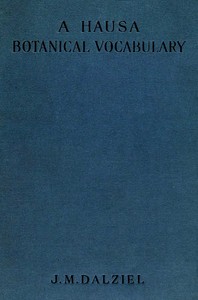
A HAUSA BOTANICAL VOCABULARY
A HAUSA BOTANICAL VOCABULARY
BY JOHN M. DALZIEL, M.D., B.Sc., D.T.M. West African Medical Staff
T. FISHER UNWIN LTD. LONDON: ADELPHI TERRACE
_First published in 1916._
(_All rights reserved_)
A HAUSA BOTANICAL VOCABULARY
=abakuru=, a food made from the ground-bean; _vide_ under =kwaruru=.
=abantoko=, a var. of =dawa= _q.v._
=abawa=, _vide_ under =abduga=.
=abduga= or =auduga=, indigenous species of Gossypium (Malvaceæ)—G. peruvianum, Cav. G. punctatum, Sch. et Thon. G. obtusifolium, Roxb. G. arboreum, L. with varieties, hybrids and other introduced species. The Cotton Plant or raw cotton. Syn. =kaḍa= (Sok.). Varieties known in different districts are:—_ba ka tuka_, or _ba tuka_, _ya tabshi_, _ya tsauri_, or _ya ḳarifi_, _kwanta Ali da zugu_, _Ba-Gwandare_, _yar gari_ (G. obtusifolium, var. africana, Watt.), _gwundi_ (G. peruvianum var. with red leaf veins), _chukwi_, _laḅayi_ (G. punctatum), and _kanawa_ or _matan kanawa_ (G. arboreum, L. var. sanguinea, Watt.); the leaves of the last or of _gwundi_ are used for making a red dye for thread. _guriya_ (Sok.), _anguriya_ (Kano), or _yan guriya_ = cotton seed; _sutu_ or _subtu_ = cotton freed from the seed by crushing with a stone and roller and pulled by hand before carding with the _masaḅi_ or _bakan shiḅa_ (cotton carding bow); _saḅi_ or _shiḅa_ = carded cotton; _zare_ = thinly plied cotton thread, used chiefly for the warp, and sometimes for warp and weft; _abawa_ (Kano), or _bartake_ (Sok.) = thicker loosely plied thread used for the weft; (the coarse cloth _goddo_, or _nuru_ (East Hausa), woven on a vertical loom in broad strips and with a fringe, has _abawa_ in warp and weft); _waḍari_ = cotton yarn ready for weaving; _fari_ (Kano) = woven cotton strips; _zugu_ (Sok.) = cotton strips in a roll (= _kunkurun fari_, Kano); _sawaye_ (Sok.) = the same unrolled; _taḅe_ (Sok.), or _chin aduga_ (Kano) = to pluck cotton out of the pod.
=abokin kibiya=, a tall grass used for arrow-shafts; _vide_ =ḳyamro=.
=aburu=, a grass used for food; _vide_ =iburu=.
=acha=, Digitaria exilis, Stapf. (Paspalum exile, Kipp.) (Gramineæ); a small grass cultivated as a cereal in several Hausa provinces, in Bornu, and by many pagan tribes. Syn. =intaya= (Sok. Kamberi, Kamuku, &c.), “Hungry Rice”. _cf._ also =tumbin jaki=.
=a chi da gero=, =a chi da kara=, =a chi da nono=, vars. of Guinea Corn; _vide_ under =dawa=.
=aduruku=, Newbouldia lævis, Sun. (Bignoniaceæ); a tall slender tree with handsome purple flowers; often planted around native compounds. Syn. =ba reshe?=
=aduwa=, Balanites ægyptiaca, Del. (Simarubeæ). “Desert Date”; a thorny tree common in the north, deciduous but with evergreen branches, bifoliate leaves and yellow bitter-sweet fruit; its gum = _ḳaron aduwa_; the seeds yield “Oil of Betu” (Kanuri, _bito_); _dabagira_ = flowers of _aduwa_, boiled and eaten with _daudawa_, _q.v._ salt and pepper; _kaikwaiyo_ (Sok. Kano, &c.) = the kernel, sold as a medicine. Fruit edible; a common ingredient in fish-poison.
=ago= or =agu= (Gwari); a fish-poison, prepared usually from Tephrosia Vogelii (_cf._ =baina=, _vide_ under =majimfa=); sometimes from the pods of Cassia spp. (_vide_ =gamma faḍa=, &c.); _cf._ =aduwa=.
=agugu=, a native drug; the rhizome of a fern used for tapeworm; probably = “Male Fern” (Nephrodium Filix-mas); not indigenous; brought chiefly from Adamawa.
=agushi=, the seeds of a var. of the Water Melon, Citrullus vulgaris (_vide_ =guna=); chewed raw or used in soup.
=aguwa= _vide_ =ḳaguwa=.
=akiye= or =akwiye=, the seeds of =kiriya=, _q.v._
=akwalu= (Kano and East), Trochomeria sp. (Cucurbitaceæ); a wild twiner with a large tuberous root, edible when cooked. Syn. =basko=, or =basgo= (West Sokoto).
=akwuya=, a var. of =dawa=, _q.v._
=alale=, Blighia sapida, Koenig (Sapindaceæ). “Akee apple”; a tree found in the southern provinces, with red capsular fruit; the spongy white aril around the seeds is edible. (?Nupé _ella_ = the name of the fruit). In Hausa generally called =Gwanja kusa=, _q.v._
=alambo=, Sesbania leptocarpa, DC. (Leguminosæ); a slender branched tree with yellow flowers and narrow jointed pods, common on river-banks. (Kanuri, _paiya paiya_). Other species are included, e.g. S. aculeata, Pers. S. ægyptiaca, Poir, &c.; _cf._ also =sasabani= and =zamarke=.
=alayafu=, Amaranthus caudatus, L. (Amaranthaceæ). Native spinage; an excellent cultivated vegetable; a red variety resembles the ornamental plant “Love-lies-bleeding.” =farin alayafu=, Celosia argentea, L. (Amaranthaceæ); an erect weed of fields, 1 to 2 feet high, with pink and silvery flowering spike, not cultivated but used as a pot-herb.
=albasa=, Allium Cepa, Willd. (Liliaceæ). The onion. Two varieties are distinguished, viz. _guda_ (Kano), or _gudaji_ (Sok.), the common bulbous onion; and _shafa_ (Kano), _safa_ (Sok.), the spring onion; _lawashi_ or _gabu_ (Sok.) = onion leaves pounded and dried, sold in the form of balls and used in soup. _cf._ =tafarnuwa=.
=albasar kura=, Urginea nigritiana, Bak. (Liliaceæ), and other common bulbous plants growing wild.
Dalziel's vocabulary is organized as a Hausa-to-English dictionary of plant names, but the entries quickly exceed simple translation. Under abduga (cotton), for instance, he lists not only the scientific species but also regional synonyms (kaḍa in Sokoto), named varieties (ba ka tuka, gwundi), and a chain of processing terms from raw cotton (sutu) through carded fiber (saḅi) to woven strips (fari). The catalog subjects classify the work under Economic Botany and Plant names, yet the text itself is as much a record of Hausa linguistic and technical knowledge as it is a botanical inventory.
Beyond Scientific Names: Local Knowledge Embedded in Entries
The vocabulary does not merely pair Hausa terms with Linnaean binomials. Many entries include detailed notes on preparation, use, and cultural significance. For kuka (baobab), Dalziel records that the inner bark is used for rope and musical instrument strings, the fruit pulp is eaten and drunk, and the seeds are fermented into cakes called daudawar kuka or katsami. He also notes that pounded leaves mixed with dusa and kanwa serve as horse food or medicine. These observations, drawn from the excerpts, show that the vocabulary functions as an ethnobotanical field guide, not a sterile list.
Regional Variation and Synonymy
Dalziel consistently marks where a plant name differs by location. Auduga (cotton) is kaḍa in Sokoto; kubewa (okra) is guro in Sokoto and takeyi in East Hausa; kuriya (silk cotton tree) is synonymous with gurjiya. The entry for kudaku (sweet potato) simply cross-references dankali. This attention to dialectal and regional usage suggests that Dalziel collected data from multiple informants across Hausa-speaking areas, and that the vocabulary is as much a linguistic document as a botanical one.
Material Culture and Economic Uses
Many entries describe how plants are processed into objects or substances. Kuloko is a black leather dye made from fermented bagaruwa pods mixed with blacksmiths' refuse and honey. Kufi is an oily extract from castor oil, physic nut, and aduwa seeds, used for sores on livestock. Kukuki yields a gum like tragacanth, and its bark contains a watery juice sucked by thirsty carriers. These details align with the catalog subject Economic Botany, but they also reveal a web of craft knowledge—dyeing, rope-making, veterinary medicine—that the vocabulary preserves.
Readers should approach this vocabulary not as a dry reference but as a layered record of how Hausa speakers named, classified, and used their botanical environment. The scientific identifications anchor the entries, but the real substance lies in the synonyms, processing terms, and cultural notes. Dalziel's work rewards those who read across entries, tracing how a single plant like cotton or baobab branches into multiple products and practices.
I remember Dalziel’s vocabulary, where each Hausa name for a plant held a quiet argument about place and use, as if the language itself were a herbarium. It reminds me of the gentle kinship in The Book of Herbs — Text and Context, where old recipes and remedies whisper the same patient attention to the living world, one root at a time.
There are no reviews for this eBook.
There are no comments for this eBook.
Reader reflection
How will you remember this book?
Save your reaction, strongest insight, and memorable passage.
Your progress
0
/
10
2
How much did you enjoy the reading experience?
3
Would you encourage someone else to read it?
4
How demanding did the text feel?
5
Was the book what you thought it would be?
6
Would you read this book again?
7
Would you start a conversation about this book?
8
How understandable was the text?
9
What is the main idea you are taking away?
10