1

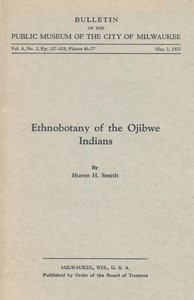
Ethnobotany of the Ojibwe Indians — Text and Context
(0 User reviews)
68
Project Gutenberg
2015
Not confirmed
Ojibwa Indians -- Ethnobotany; Plants -- Wisconsin; Plants -- Minnesota
Readers of public-domain and historical texts
Project Gutenberg digital edition
en
Edition facts
Words
44,568
Reading time
194 min
Text sections
8
Before opening Ethnobotany of the Ojibwe Indians — Text and Context, the edition data offers a quick orientation: 44,568 words, 3 hr 14 min estimated reading time, and 8 detected text sections.
The text analysis averages about 16.2 words per sentence, while the detected sections provide another way to judge how the source is divided.
Project Gutenberg metadata also associates the work with “Ojibwa Indians -- Ethnobotany,” connecting these edition facts with the source record’s subject description.
Source:
Project Gutenberg record #49527
Huron H. Smith's 1932 bulletin documents Ojibwe plant uses in Wisconsin and Minnesota, organized by botanical family. The text pairs Ojibwe and Latin names with precise descriptions of harvesting, preparation, and storage, revealing a system where plants serve multiple purposes—food, medicine, fiber, dye—and where ecological knowledge is embedded in everyday practice.
Editorial Edition Score
4.7/5
★★★★★
★★★★★
Calculated from edition completeness, EPUB availability, text structure and catalogue metadata. Not a user rating.
How this score is calculated
- Description quality20 pts
- Title & short description10 pts
- Source metadata20 pts
- Text length15 pts
- Chapters / structure15 pts
- EPUB file integrity20 pts
Total of 100 points, scaled to a 2.5-5.0 range. Editions with an empty description or a missing EPUB file are not scored.
Edition quality
Read the Text
issued for the arrest of the more than twenty Indians who had assisted in the rescue. Since the marshals feared the Indians, they asked for the assistance of troops. It was thought that a show of force by regular troops would be sufficient. Twenty men of the Third Regiment U. S. Infantry were sent, but since the Indians showed no sign of yielding eighty more left Fort Snelling for Walker, Minnesota. Major M. C. Wilkinson and General J. M. Bacon were in charge.
Two small lake steamers and a barge took the troops to Bear Island, and they anchored in shoal water just across from the island, proceeding by barge to the mainland. The battle took place at the house of Bujonegicig, who died only a few years ago. The troops were fired upon from the woods and Major Wilkinson, Sergeant Butler and four privates were killed. Ten were wounded. On October 6, 1898, 214 more troops came to assist, but no further firing was encountered and the uprising was over. The Commissioner of Indian Affairs, W. A. Jones, arrived from Washington, October 10. The next morning he and Father Aloysius, a priest with great influence over the Indians, held a long and friendly conference with the Pillager chiefs investigating and settling the timber complaints. Troops flooded that country and persuaded the Bear Islanders to respond to the warrants. They were duly tried, sentenced and fined, but the fines were remitted and after two months imprisonment the sentences were commuted and pardons granted.
The writer found but few who remembered the battle, for while there were over a hundred men able to bear arms in 1898, the Ojibwe could not successfully fight the influenza attack of 1919 and the present population consists of only fourteen persons: John Peper, wife, daughter and mother; White Cloud, shown in plate 59, fig. 2, wife and son; Moîckaˈwus and wife; John Smith, Frank Marshall, wife and two children. John Peper’s mother was said to be 106 years old and looked the part, as shown in plate 59, fig. 1. John, her youngest boy was past 70 years of age. Another very old resident, John Smith, had died the year before the writer arrived. His age was said to be 138 years. His recollections are said to have included George Washington as President of the United States.
All of our Ojibwe residents in Wisconsin and those in Michigan and Minnesota were forest Indians and, as such, great hunters, although they cultivated maize in a small way. They made very superior birch bark canoes and were at home on the many lakes of the northland, subsisting largely on fish and game. While at the present time, they dress themselves to satisfy the pre-conceived ideas of tourists, in the early days, their headdress consisted of otter skin caps, often embellished with eagle feathers, one for each enemy slain in battle and consequently for each scalp secured. The great feathered bonnet was not of their culture, but has been more recently borrowed from the Plains Indians. They never used the tepee of the Plains Indians, such as is shown in plate 46, fig. 2, and in plate 58, fig. 2, but built a wigwam. The wigwam was easily constructed in a half-day’s time. Poles were thrust into the ground in a circle of from twelve to twenty feet, their tips bent and securely tied in the center with basswood bark cord to form a hemisphere, about eight feet in height at the center. The whole was then covered with bark of balsam, or woven cat-tail mats, such as the one shown in plate 46, fig. 2, and roofed with birch bark. An entrance and smoke hole were left and mats thrown upon the ground. It was much warmer than a tepee and better adapted to the heavy snow fall of the north, and to low temperatures. All of their storage houses and their smaller sweat lodges were similarly made. Their medicine lodges followed the same construction though they were much longer: being eighty, a hundred and even a hundred and fifty feet in length.
Huron H. Smith’s 1932 bulletin, published as part of the Milwaukee Public Museum series, records the plant knowledge of Ojibwe communities in Wisconsin and Minnesota. The work is organized by botanical family, with each entry pairing the Ojibwe name—often a descriptive compound such as bakwaˈ nak (“binding tree”) for Smooth Sumac—with the Linnaean binomial. Smith does not merely list species; he describes how plants are gathered, processed, and used, and he notes differences between bands, as when the Pillager Ojibwe employ Arum-leaved Arrowhead as both food and medicine while the Flambeau use it only for food.
Naming and Classification
Smith’s entries consistently give the Ojibwe name first, often with a literal translation in brackets. Wabasiˈ pîn (“white potato”) for Arum-leaved Arrowhead and nameˈ pîn (“sturgeon potato”) for Wild Ginger show that the names encode appearance or association. The botanical family headings (e.g., ALISMACEAE) impose a Western framework, but the Ojibwe names reflect a different taxonomy—one based on utility and sensory qualities. Smith also records variant names: Common Milkweed is called both caboˈ sîkûn (“milk”) and înîniwûnj (“Indian plant”) by the Flambeau, suggesting multiple layers of reference.
Harvesting and Processing Techniques
The excerpts reveal meticulous methods tied to the properties of each plant. Arrowhead corms are described as attached by a “tiny rootlet” that makes them difficult to dig; Ojibwe harvesters instead raid muskrat and beaver caches. Maple sap is boiled, strained, and pounded in a wooden trough as it hardens, then stored in birch-bark mokoks of up to seventy-five pounds. Wild Ginger roots are processed in lye water for large-scale cookery. These details show that preparation is not casual: each step—from digging to storage—is adapted to the plant’s structure and the intended use.
Multiple Uses and Seasonal Cycles
Smith documents how a single species can serve several purposes. Smooth Sumac berries are made into a cold drink in summer and a hot, sweetened one in winter; the dried seed heads are stored for later use. Common Milkweed flowers and shoot tips are eaten fresh in soups or dried for winter. Arrowhead corms are boiled with deer meat and maple sugar, and leftover cooked corms are candied. The text also notes that spilling maple sap is considered an affront to deities, who cause the sugar to shrink—a belief that reinforces careful handling.
Dialogue Between Bands and with the Land
Smith frequently compares practices of the Flambeau and Pillager Ojibwe, showing that knowledge is not uniform. The Pillager use Arrowhead as a medicine for man and horse; the Flambeau do not. Wild Ginger is used by the Pillager to season food and counteract muddy taste in fish. These differences suggest that plant use is shaped by local ecology and cultural transmission. Smith also notes that Ojibwe recognize animal behaviors—muskrats store arrowhead corms, ducks feed on the plants—indicating a close observation of interspecies relationships that informs human harvesting.
Readers should attend to the interplay between Ojibwe nomenclature and Smith’s botanical framework. The bulletin is not a static catalog but a record of dynamic knowledge: each entry embeds ecological observation, seasonal timing, and cultural preference. Smith’s own voice is restrained, letting the plant names and uses speak. The work rewards a slow reading that follows the threads connecting a single species across food, medicine, and belief.
Flipping through Smith’s notes on Ojibwe willow bark, I thought of how each remedy holds a quiet, deliberate chemistry, much like the plants in The Seven Sisters of Sleep Popular History of the Seven Prevailing Narcotics of the World — Key Ideas to Explore—both worlds treat nature’s gifts as gentle, potent companions rather than simple tools, each with their own whispered, ancient logic.
There are no reviews for this eBook.
There are no comments for this eBook.
Reader reflection
Your personal reading reflection
Build a private reading journal entry for this title.
Your progress
0
/
10
2
How much did you enjoy the reading experience?
3
Would you recommend this book to another reader?
4
How demanding did the text feel?
5
Did the book deliver what you hoped for?
6
How useful did the reading feel?
7
What was the strongest part of the book?
8
Did you relate to its people, ideas, or situations?
9
What is the main idea you are taking away?
10