1

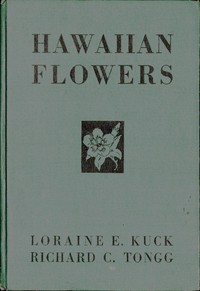
Hawaiian Flowers — Reading Companion
(0 User reviews)
1185
Project Gutenberg
2018
Not confirmed
Wild flowers -- Hawaii; Plants -- Hawaii
Readers of public-domain and historical texts
Project Gutenberg digital edition
en
Edition facts
Words
30,979
Reading time
135 min
Text sections
6
Before opening Hawaiian Flowers — Reading Companion, the edition data offers a quick orientation: 30,979 words, 2 hr 15 min estimated reading time, and 6 detected text sections.
The text analysis averages about 18.7 words per sentence, while the detected sections provide another way to judge how the source is divided.
Project Gutenberg metadata also associates the work with “Wild flowers -- Hawaii,” connecting these edition facts with the source record’s subject description.
Source:
Project Gutenberg record #58034
An editorial note on how the preface, chapter structure, and plant descriptions in Kuck and Tongg's 1943 guide shape a first reading of Hawaiian flora, with attention to wartime context and the interplay of scientific and lay language.
Editorial Edition Score
4.7/5
★★★★★
★★★★★
Calculated from edition completeness, EPUB availability, text structure and catalogue metadata. Not a user rating.
How this score is calculated
- Description quality20 pts
- Title & short description10 pts
- Source metadata20 pts
- Text length15 pts
- Chapters / structure15 pts
- EPUB file integrity20 pts
Total of 100 points, scaled to a 2.5-5.0 range. Editions with an empty description or a missing EPUB file are not scored.
Edition quality
Read the Text
Produced by Stephen Hutcheson and the Online Distributed Proofreading Team at http://www.pgdp.net
_By_ LORAINE E. KUCK _and_ RICHARD C. TONGG
_Illustrated by_ TED MUNDORFF
TONGG PUBLISHING COMPANY, HONOLULU 1943
By the same authors THE TROPICAL GARDEN Its design, horticulture and plant materials.
_Copyright 1943 By Loraine E. Kuck and Richard C. Tongg All rights reserved. Printed in Honolulu, Hawaii, U.S.A._
The working title of this book during its preparation was that question so often on the lips of tourists in Hawaii,
“What flower is that?”
Had there still been tourists in Honolulu, it is likely that that name would have been used on the cover, for the book is designed to help answer it. Now that the islands are filled with visitors intent on more serious business than pleasure, it has seemed best to call it simply “Hawaiian Flowers.” It is published at this time in the hope that some of these visitors may find in it an hour’s escape from the strain and pressure of war. For, in spite of war, the flowers still bloom in Honolulu, often right over the bomb shelters that fill gardens and parks.
In using the book to help identify the island flowers, it is hoped that the color plates and descriptions together, will make it fairly easy for the layman. Persons interested in more serious study will know how to go to more technical works for information. Care has been taken to have each name accurate to aid those going to the accepted authorities.
In making the color plates the attempt has been made to have them both artistic and scientific, a difficult undertaking under any circumstances. In striving to present pictures of individual flowers so they may be identified, it has been necessary, at times, to sacrifice the gorgeous effects presented in nature by masses of these flowers; such, for instance, as is seen on the Shower trees. The writers wish to take this opportunity to thank Ted Mundorff, the artist, for his trouble in making the reproductions as accurate as possible.
They wish, also, to express appreciation to Mr. Edward L. Caum, botanist with the Hawaiian Sugar Planters’ Experiment Station, for reading the manuscript and checking the botanical information it contains. Mrs. Arthur Silverman, in the Library of Hawaii, has been most helpful in looking up obscure references.
Works consulted in preparing the book include Rock’s “Ornamental Trees of Hawaii,” and his “Indigenous Trees of Hawaii”; Marie Neal’s book, “In Honolulu Gardens” and Bailey’s Cyclopedia of Horticulture.
PAGE _Introduction_ Where to See Hawaiian Flowers 11 _Chapter I_ Hawaii’s Own Flower, The Hibiscus 17 _Chapter II_ The Blossoming Trees 23 _Chapter III_ Native Trees 39 _Chapter IV_ Tropical Shrubs 47 _Chapter V_ Colored Foliage Shrubs 65 _Chapter VI_ Flowering Vines 71 _Chapter VII_ Ginger Blossoms 87 _Chapter VIII_ Special Tropical Flowers 93 Index 103
List of Illustrations
OPPOSITE PAGE _Plate I_ Hibiscus 16 _Plate II_ Flowering Trees 16 _Plate III_ Flowering Trees 16 _Plate IV_ Flowering Trees 16 _Plate V_ Native Trees 48 _Plate VI_ Tropical Shrubs 48 _Plate VII_ Tropical Shrubs 48 _Plate VIII_ Tropical Shrubs 48 _Plate IX_ Tropical Shrubs 64 _Plate X_ Colored Foliage Shrubs 64 _Plate XI_ Flowering Vines 64 _Plate XII_ Flowering Vines 64 _Plate XIII_ Flowering Vines 80 _Plate XIV_ Ginger Blossoms 80 _Plate XV_ Special Tropical Flowers 80 _Plate XVI_ Special Tropical Flowers 80
Introduction WHERE TO SEE HAWAIIAN FLOWERS?
If you are already in Hawaii, this question will seem purely rhetorical, since the answer is so obviously, “Anywhere.” There are few places indeed, in the islands, where flowers of some sort are not in sight. Mostly, of course, these are the Hibiscus, but you will soon notice others and the quest for new ones is apt to develop into a full-sized hobby. For the benefit of newcomers, a few of the gardens, parks and drives where you will find many Hawaiian trees and flowers are given here. By the time you have covered these places, you will know how to go on by yourself.
ROYAL HAWAIIAN HOTEL GARDEN
Few finer, tropical gardens can be found in the Islands than the one which forms a setting for the Royal Hawaiian Hotel at Waikiki. Not only does it contain a very large assortment of trees, shrubs and special tropical plants, many of them rare, but it has been laid out to make the very most of the charm inherent in the words “tropical garden.” There are cool, green, jungle depths, gorgeous blossoms and wide shady lawns, all beautifully maintained.
The preface to Hawaiian Flowers immediately frames the book as a wartime publication, noting that the islands were “filled with visitors intent on more serious business than pleasure” and that flowers still bloomed “over the bomb shelters.” This context is not merely historical color; it explains the authors’ decision to name the book simply “Hawaiian Flowers” rather than the working title “What flower is that?”—a question they say was “so often on the lips of tourists.” The preface thus orients the reader to a guide designed for identification under unusual circumstances, balancing practical botany with a hint of escapism.
From Preface to Plate: The Book’s Dual Audience
The preface explicitly addresses two kinds of readers: the layperson seeking to identify flowers, and the “more serious” student who will consult technical works. This split is visible throughout the excerpts. For the general reader, descriptions emphasize visual and sensory details—the “miniature, holly-like leaves, crisp, shining and thorny” of Singapore Holly, or the “pompons of pink or white stamens” of Haole Lehua. For the botanically inclined, each entry includes Latin names, family classifications, and native ranges (e.g., Euphorbia splendens from Madagascar). The color plates, the preface explains, aimed to be “both artistic and scientific,” though mass effects like those of Shower trees were sacrificed for individual clarity. A first-time reader benefits from noting which details are meant for quick spotting and which for taxonomic precision.
The Structure of a Single Entry: What to Expect
Each plant description in the excerpts follows a consistent pattern: common name, scientific name and authority, then a physical description that moves from overall form to specific parts. The Crown of Thorns entry, for instance, begins with “Quantities of very long, sharp thorns on a low shrub bearing small, red flowers,” then zooms in on the “rosy-scarlet flowers” and their bracts. Next comes habitat or use—the Crown of Thorns is “sometimes planted in areas from which it is desired to keep people”—and finally botanical family and native origin. This structure lets a reader quickly locate key identification cues. The entries also occasionally include historical or cultural notes, such as the association of Jasmine with Princess Kaiulani’s white peacocks at Ainahau. These asides are rare but enrich the otherwise straightforward botanical prose.
Local Names and Colonial Layers
The book records multiple names for many plants, revealing layers of Hawaiian, English, and imported terminology. The entry for Cassia glauca gives the Hawaiian name “Kalamona,” noting it was “transferred to this plant from a native Cassia of similar appearance.” Similarly, “Haole Lehua” (foreign Lehua) is applied to Calliandra because its flowers resemble those of the native Ohia Lehua. These naming practices show how introduced species were absorbed into local vocabulary. The authors do not dwell on this, but a careful reader will notice the pattern: common names often reflect resemblance or substitution, not botanical relationship. The preface’s promise that “each name accurate to aid those going to the accepted authorities” suggests the authors were aware of the potential for confusion and tried to standardize.
Wartime Details and the Living Landscape
Beyond the preface, wartime references appear in the plant descriptions themselves. The Crown of Thorns is noted as growing in the “parking strip before the Advertiser building”—a mundane detail that becomes a small landmark. More strikingly, the preface mentions bomb shelters in gardens and parks, and the book’s publication in 1943 is itself a wartime act. The authors hope the book offers “an hour’s escape from the strain and pressure of war.” This framing gives the botanical descriptions an unexpected poignancy: the flowers are not just specimens but persistent elements of daily life under duress. A first-time reader might watch for other subtle signs of the period, such as references to specific buildings or uses of plants in defense-related landscaping, though the excerpts provide only these few examples.
Because the excerpts cover only the preface and a handful of entries from Chapter IV (Tropical Shrubs) and later chapters, a first reader should not assume the entire book follows the same tone or density of cultural notes. The later chapters on flowering vines, ginger blossoms, and special tropical flowers may introduce different structural patterns or more technical language. To get the most from this guide, read the preface carefully for the authors’ stated intentions, then sample entries from different chapters to gauge consistency. The color plates, though not reproduced in this digital edition, are referenced throughout and were clearly integral to the identification system.
This reminded me of my grandmother’s shelf, where her 1943 guide felt like a quiet hand holding mine through names I couldn’t pronounce. The same gentle patience lives in Flowers of mountain and plain — Text and Context, where landscape and history breathe softly beneath each description. I remember sitting with that one, too, feeling less alone in my slow noticing.
There are no reviews for this eBook.
There are no comments for this eBook.
Reader reflection
How will you remember this book?
Save your reaction, strongest insight, and memorable passage.
Your progress
0
/
10
2
Was reading this book enjoyable?
3
Would you pass this book on to a friend?
4
Did the language feel accessible?
5
Did this book create an emotional response?
6
Would a second reading be valuable?
7
How strong was your personal connection to the text?
8
How original did the book feel?
9
What is the main idea you are taking away?
10