1

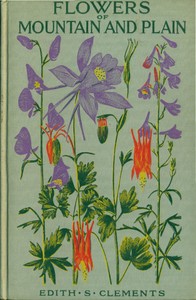
Flowers of mountain and plain — Text and Context
(0 User reviews)
1859
Project Gutenberg
2014
Not confirmed
Flowers -- Rocky Mountains; Flowers -- West (U.S.)
Readers of public-domain and historical texts
Project Gutenberg digital edition
en
Edition facts
Words
17,109
Reading time
75 min
Text sections
5
The catalog record for Flowers of mountain and plain — Text and Context provides practical reading context through 17,109 words, 1 hr 15 min estimated reading time, and 5 detected text sections.
The text analysis averages about 15.0 words per sentence, while the detected sections provide another way to judge how the source is divided.
Project Gutenberg metadata also associates the work with “Flowers -- Rocky Mountains,” connecting these edition facts with the source record’s subject description.
Source:
Project Gutenberg record #47339
Edith S. Clements' field guide pairs 25 color plates with concise descriptions of 175 Rocky Mountain flowers, emphasizing elevation ranges, bloom times, and practical details for travelers. The second edition adds a simple text to aid identification and foster preservation.
Editorial Edition Score
4.6/5
★★★★★
★★★★★
Calculated from edition completeness, EPUB availability, text structure and catalogue metadata. Not a user rating.
How this score is calculated
- Description quality20 pts
- Title & short description10 pts
- Source metadata20 pts
- Text length15 pts
- Chapters / structure15 pts
- EPUB file integrity20 pts
Total of 100 points, scaled to a 2.5-5.0 range. Editions with an empty description or a missing EPUB file are not scored.
Edition quality
Read the Text
Flowers of Mountain and Plain
_Edith S. Clements, Ph. D._
The H. W. Wilson Company New York 1926
Copyright 1926 by Edith S. Clements Reprinted June 1945 Reprinted November 1949 Reprinted March 1955
Printed in the United States of America
“Flowers of Mountain and Plain” is intended primarily for travelers and flower lovers who wish a short cut to recognizing flowers seen on excursions or from car windows. It may also serve as a souvenir of pleasant summer days or vacation trips. The book consists of the twenty-five color plates to be found in “Rocky Mountain Flowers” (Clements and Clements, 1914), representing one hundred and seventy-five of the most beautiful and striking flowers of the mountains and plains of the West. If it succeeds in opening the eyes of the passer-by to an appreciation of the flowers by the way, or in further stimulating an already awakened interest, it will have served its purpose. Edith S. Clements.
_University of Minnesota_ _March 30, 1915_
PREFACE TO THE SECOND EDITION
Opportunity has been taken of the demand for a second edition of “Flowers of Mountain and Plain” to add a simple text to the plates. It is hoped that this will increase the interest in the flowers of the region and help create a sentiment in favor of their preservation. Edith S. Clements.
_Alpine Laboratory,_ _Manitou, Colorado,_ _July 9, 1920._
Flowers of Mountain and Plain
Monkshood, Aconite Aconitum columbianum
The flowers of the Monkshood are usually deep purple-blue, but yellowish white ones are often found. The tall plants, 4-8 ft. high, grow in mountain meadows and along streams at 6000-12000 ft., and bloom from early July to late August. The Aconite disguises its relation to the buttercups by having irregular sepals, developed by insect visitors in search of nectar. The two nectaries are underneath and at the base of the cowl-shaped upper sepal which gives the plant its name. In seeking nectar, the bees crawl over the group of stamens and stigmas and in so doing either collect or deposit the pollen which clings to their legs and abdomens. The Monkshood is frequently cultivated in gardens and some of the species furnish a powerful drug, aconite, used in medicine. All are poisonous and often produce fatal results among stock when feed is scarce.
Blue Columbine Aquilegia coerulea
This Columbine varies in color through several shades of blue and may rarely be white. It is the state flower of Colorado, growing in spruce and aspen woods, or in mountain meadows at 6500-12000 ft. It is usually 2-3 ft. high and blossoms from early summer to midsummer. Like the Monkshood and Larkspur, the columbines also belong to the group of irregular buttercups. The nectar is contained in the swollen tips of the petals. Pollination is effected by long-nosed bees which cling to the petals while inserting the proboscis up the spur and at the same time touch the group of pendant stamens with the underside of the body. Short-nosed bees are unable to get at the nectar in this way and steal the honey by biting holes in the tips of the spurs. The columbines make beautiful garden plants and the Blue Columbine as well as one or two other native species is cultivated. The ordinary columbine of the garden, however, belongs to the European _Aquilegia vulgaris_. The name “Aquilegia” is derived from the Latin “aquila,” eagle, and probably refers to the resemblance of the spurred petals to eagles’ talons.
Red Columbine Aquilegia canadensis
The blossoms of this plant are bright red, usually more or less tinged with yellow. It is 1-2 ft. tall, grows on wooded mountain-sides at 7500-11000 ft. and blooms in July and August. The mountain form has smaller, more brightly colored flowers than the eastern plant.
Blue Larkspur Delphinium scopulorum
The Larkspur, like the Monkshood, has developed oddly shaped sepals, but the upper one, instead of resembling a cowl, is more like the spur of a bird. The common name refers to this resemblance. The plants grow as tall as 6-8 ft. and are found on foothills and mountain-sides at 5000-10000 ft. They bloom in midsummer and the flowers vary from pale blue to deep purple-blue. The Blue Larkspur, like many other species of larkspur, is poisonous to stock.
Anemone, Wind Flower Anemone multifida
This Anemone is usually white, but it varies through pink to deep rose-red. It is 1-2 ft. tall, grows in meadows and on hillsides at 7000-12000 ft. and blooms throughout the summer. Most anemones have an acrid juice which irritates the skin and is poisonous if taken internally. They make very attractive garden plants, though the native species are little cultivated as yet.
Alpine Clematis Clematis alpina
Edith S. Clements' Flowers of Mountain and Plain (second edition, 1920) is a compact field guide built around twenty-five color plates that depict 175 flowers of the Rocky Mountains and western plains. The preface frames the book as a tool for travelers and flower lovers who want a quick way to recognize plants seen on excursions or from car windows. Clements, a botanist with a Ph.D., wrote the text to accompany plates originally published in Rocky Mountain Flowers (1914). The entries are organized by plant family, beginning with the Buttercup family, and each species account gives a precise elevation range, bloom period, and distinctive features such as flower color, leaf shape, or growth habit.
Elevation as a Key Identifier
Clements consistently reports elevation ranges for each species, often with a span of several thousand feet. For example, Monkshood grows at 6000–12000 ft., while Alpine Clover is found only at 12000–14000 ft. on alpine peaks. This emphasis on altitude is not incidental: it helps a reader narrow down possibilities based on where they are hiking or driving. The book covers plants from plains at 4000 ft. to alpine summits above 14000 ft., making elevation one of the most practical filters for identification. The author also notes habitat details—meadows, streamsides, spruce woods, or dry hills—that further refine the search.
Bloom Time and Seasonal Progression
Each entry includes a bloom period, often as broad as “all summer long” (Alfalfa) or as narrow as “midsummer” (Alpine Clover, King’s Crown). Many species are tied to early summer or midsummer, reflecting the short growing season at high altitudes. The book implicitly maps a seasonal progression: early bloomers like the Rose Locust appear in spring and early summer, while later flowers such as Monkshood extend into late August. A reader can use these time windows to anticipate which flowers are likely to be in peak display during a given trip, and to understand how flowering shifts with elevation.
Practical and Historical Notes
Clements frequently includes brief notes on human uses, toxicity, or curiosity. Monkshood is noted as poisonous to stock and a source of the drug aconite. Loco weed is described as causing fatal livestock losses, with a recent cure mentioned. Alfalfa, an escaped cultivar, was ground into meal as a flour substitute during World War I. These details ground the botanical descriptions in economic and historical context, reminding the reader that these plants have mattered to people beyond their beauty. The book also notes that the state flower of Colorado is the Blue Columbine, and that clover leaves fold up at night.
Structure and How to Use the Book
The book is organized by plant family, starting with Buttercup family and proceeding through Pea family, Stonecrop family, and others. Each family is introduced with a plate number and a set of figures keyed to the illustrations. The text entries are short, typically three to five sentences, and follow a consistent pattern: flower color, plant height, habitat, elevation, bloom time, and occasional extra facts. This uniformity makes it easy to scan for key data. The preface states the book is meant for quick recognition, not exhaustive botany. A first-time reader should flip to the plate that matches the flower in hand, then check the corresponding entry for confirmation.
Clements' guide rewards a patient reader who pays attention to the three-part formula: elevation, bloom time, and habitat. The book does not attempt to cover every flower of the region, but focuses on 175 of the most striking and common species. For a traveler with this volume in hand, the best approach is to note the altitude and season of the sighting, then scan the plates for a visual match. The text will confirm the identification and often add a memorable detail about the plant's role in the landscape or human economy.
Among the shelves, Flowers of Mountain and Plain rests quietly, its pages tracing elevation and bloom for travelers who pause. I often think of it beside another patient observer—Darwin, notebook in hand, watching tendrils find their way. Both books share a gentle curiosity, a trust that small, careful attention reveals the world’s hidden order. The Movements and Habits of Climbing Plants — Reading Notes feels like an old friend to that flower guide, whispering that growth, too, has its quiet grammar.
There are no reviews for this eBook.
There are no comments for this eBook.
Reader reflection
What was your reading experience?
Capture what you thought, learned, and would like to remember.
Your progress
0
/
10
2
What was your overall reaction to the book?
3
Would you pass this book on to a friend?
4
How demanding did the text feel?
5
How useful did the reading feel?
6
Did any part of the book feel personally relevant?
7
Did anything about the book feel genuinely new?
8
Did this book create an emotional response?
9
Which lesson or insight stayed with you?
10