1

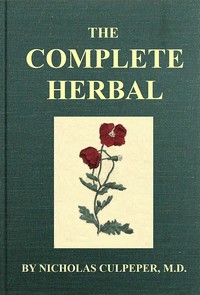
The Complete Herbal To which is now added, upwards of one hundred additional herbs, with a display of their medicinal and occult qualities physically applied to the — Story, Setting & Ideas
(0 User reviews)
977
Project Gutenberg
2015
Not confirmed
Botany, Medical; Materia medica, Vegetable; Medicinal plants -- England; Botany, Medical -- England; Herbs -- Therapeutic use; Medicinal plants
Readers of public-domain and historical texts
Project Gutenberg digital edition
en
Edition facts
Words
256,886
Reading time
1117 min
Text sections
65
The catalog record for The Complete Herbal To which is now added, upwards of one hundred additional herbs, with a display of their medicinal and occult qualities physically applied to the — Story, Setting & Ideas provides practical reading context through 256,886 words, 18 hr 37 min estimated reading time, and 65 detected text sections.
The text analysis averages about 27.3 words per sentence, while the detected sections provide another way to judge how the source is divided.
Project Gutenberg metadata also associates the work with “Botany, Medical,” connecting these edition facts with the source record’s subject description.
Source:
Project Gutenberg record #49513
Culpeper's 17th-century herbal combines plant descriptions with astrological and medicinal guidance, offering a practical system for gathering, drying, and compounding herbs. The excerpts reveal a blunt, opinionated voice that challenges learned authorities and insists on experience over tradition.
Editorial Edition Score
4.9/5
★★★★★
★★★★★
Calculated from edition completeness, EPUB availability, text structure and catalogue metadata. Not a user rating.
How this score is calculated
- Description quality20 pts
- Title & short description10 pts
- Source metadata20 pts
- Text length15 pts
- Chapters / structure15 pts
- EPUB file integrity20 pts
Total of 100 points, scaled to a 2.5-5.0 range. Editions with an empty description or a missing EPUB file are not scored.
Edition quality
Read the Text
e of the common herbs of the nation; containing a complete Method or Practice of Physic, whereby a Man may preserve his Body in Health, or cure himself when sick, with such things only as grow in England, they being most fit for English Constitutions.”
This celebrated, and useful Physician died at his house in Spitalfields, in the year 1654. This Book will remain as a lasting monument of his skill and industry.
“Culpeper, the man that first ranged the woods and climbed the mountains in search of medicinal and salutary herbs, has undoubtedly merited the gratitude of posterity.”—DR. JOHNSON.
CONSIDERING divers shires in this nation give divers names to one and the same herb, and that the common name which it bears in one county, is not known in another; I shall take the pains to set down all the names that I know of each herb: pardon me for setting that name first, which is most common to myself. Besides Amara Dulcis, some call it Mortal, others Bitter-sweet; some Woody Night-shade, and others Felon-wort.
_Descript._] It grows up with woody stalks even to a man’s height, and sometimes higher. The leaves fall off at the approach of winter, and spring out of the same stalk at spring-time: the branch is compassed about with a whitish bark, and has a pith in the middle of it: the main branch branches itself into many small ones with claspers, laying hold on what is next to them, as vines do: it bears many leaves, they grow in no order at all, at least in no regular order; the leaves are longish, though somewhat broad, and pointed at the ends: many of them have two little leaves growing at the end of their foot-stalk; some have but one, and some none. The leaves are of a pale green colour; the flowers are of a purple colour, or of a perfect blue, like to violets, and they stand many of them together in knots: the berries are green at first, but when they are ripe they are very red; if you taste them, you shall find them just as the crabs which we in Sussex call Bittersweet, _viz._ sweet at first and bitter afterwards.
_Place._] They grow commonly almost throughout England, especially in moist and shady places.
_Time._] The leaves shoot out about the latter end of March, if the temperature of the air be ordinary; it flowers in July, and the seeds are ripe soon after, usually in the next month.
_Government and virtues._] It is under the planet Mercury, and a notable herb of his also, if it be rightly gathered under his influence. It is excellently good to remove witchcraft both in men and beasts, as also all sudden diseases whatsoever. Being tied round about the neck, is one of the most admirable remedies for the vertigo or dizziness in the head; and that is the reason (as Tragus saith) the people in Germany commonly hang it about their cattle’s necks, when they fear any such evil hath betided them: Country people commonly take the berries of it, and having bruised them, apply them to felons, and thereby soon rid their fingers of such troublesome guests.
We have now showed you the external use of the herb; we shall speak a word or two of the internal, and so conclude. Take notice, it is a Mercurial herb, and therefore of very subtile parts, as indeed all Mercurial plants are; therefore take a pound of the wood and leaves together, bruise the wood (which you may easily do, for it is not so hard as oak) then put it in a pot, and put to it three pints of white wine, put on the pot-lid and shut it close; and let it infuse hot over a gentle fire twelve hours, then strain it out, so have you a most excellent drink to open obstructions of the liver and spleen, to help difficulty of breath, bruises and falls, and congealed blood in any part of the body, it helps the yellow jaundice, the dropsy, and black jaundice, and to cleanse women newly brought to bed. You may drink a quarter of a pint of the infusion every morning. It purges the body very gently, and not churlishly as some hold. And when you find good by this, remember me.
They that think the use of these medicines is too brief, it is only for the cheapness of the book; let them read those books of mine, of the last edition, _viz._ _Reverius_, _Veslingus_, _Riolanus_, _Johnson_, _Sennertus_, and _Physic for the Poor_.
Culpeper opens with a direct challenge to prevailing medical orthodoxy: he scolds “sapmongers” who believe sap falls into roots in autumn, calling their view “as rotten as a rotten post.” This combative tone, paired with his insistence on personal experience (“I have found by experience that their virtues are twice as great at such times”), immediately establishes him as a practical reformer. The book is structured as a series of numbered instructions—on gathering seeds, roots, barks—each step grounded in observable nature rather than ancient texts. Readers should expect a work that is part manual, part polemic.
A System Rooted in Observation
Culpeper’s method is built on precise, numbered rules. For seeds, he specifies they be “full ripe when they are gathered” and dried “a little in the sun” before storage. Roots require scrutiny: “chuse such as are neither rotten nor worm-eaten.” He even advises checking stored herbs monthly, drying them by a “very gentle fire” if they become moist. These details reveal a hands-on practitioner who expects the reader to be equally diligent. The instructions are not abstract; they assume the reader has access to a garden or field and the patience to follow seasonal cues.
The Celestial Harmony
Interspersed with practical advice is Culpeper’s astrological framework. He reminds the gatherer to “forget not the celestial harmony” when collecting seeds, claiming their virtues are “twice as great” at astrologically favorable times. This blend of empiricism and occult philosophy is characteristic: he treats planetary influences as a measurable factor, no different from soil or dryness. For the modern reader, this juxtaposition may seem contradictory, but for Culpeper, nature’s cycles—both earthly and heavenly—formed a single, coherent system. His confidence in this union is unwavering.
A Polemic Against the Learned
Culpeper’s contempt for academic physicians surfaces repeatedly. He dismisses the “vulgar received opinion” about sap movement with a sarcastic hypothetical: “What doth the sap do in the root all that while? Pick straws?” His target is not just folk belief but also “the learned,” whom he accuses of perpetuating untested dogma. This rhetorical strategy positions the herbal as a democratizing text—one that arms the common reader with reliable, experience-tested knowledge. The tone is blunt, even mocking, but always aimed at what he sees as harmful ignorance.
Practical Preservation and Use
The excerpts emphasize storage and longevity. Soft roots should be kept “near the fire,” while hard roots can be dried anywhere. Barks are best gathered in spring “because then they come easier off.” Culpeper also notes that common herbs like parsley need not be dried at all—gather them only for “present need.” These details reflect a household economy where medicine was prepared seasonally and stored carefully. The book functions as a reference for the long term, with advice on which materials keep for a year and which lose potency after the first season.
Culpeper’s herbal rewards a selective reading: dip into the plant entries for specific remedies, but also read the introductory chapters to understand his guiding principles. The numbered format makes it easy to locate advice on gathering, drying, or compounding. Approach his astrological claims as part of his era’s worldview rather than as literal prescriptions. The value lies in his insistence on firsthand observation—a stance that remains instructive for any reader interested in historical approaches to nature and medicine.
Thumbing through Culpeper’s blunt pages, I recalled my grandfather’s tattered field guide, the one he used while digging sassafras roots behind the barn. That old book felt like a quiet companion then, just as Ginseng and Other Medicinal Plants A Book of Valuable Information for Growers as Well as Collectors of Medicinal Roots, Barks, Leaves, Etc. — Context and Discussion does now, both speaking of earth and patience.
There are no reviews for this eBook.
There are no comments for this eBook.
Reader reflection
How will you remember this book?
Save your reaction, strongest insight, and memorable passage.
Your progress
0
/
10
2
Was reading this book enjoyable?
3
Would you encourage someone else to read it?
4
How easy was the book to follow?
5
How clearly were the main ideas presented?
6
What was its emotional impact?
7
Did the story or argument move comfortably?
8
Did you relate to its people, ideas, or situations?
9
What changed or sharpened your thinking?
10