1

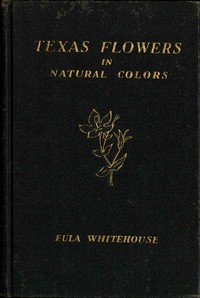
Texas Flowers in Natural Colors — Inside the Classic
(0 User reviews)
950
Project Gutenberg
2016
Not confirmed
Wild flowers -- Southwestern States; Wild flowers -- Texas
Readers of public-domain and historical texts
Project Gutenberg digital edition
en
Edition facts
Words
44,012
Reading time
192 min
Text sections
9
The catalog record for Texas Flowers in Natural Colors — Inside the Classic provides practical reading context through 44,012 words, 3 hr 12 min estimated reading time, and 9 detected text sections.
The text analysis averages about 18.8 words per sentence, while the detected sections provide another way to judge how the source is divided.
Project Gutenberg metadata also associates the work with “Wild flowers -- Southwestern States,” connecting these edition facts with the source record’s subject description.
Source:
Project Gutenberg record #53647
An editorial note on Eula Whitehouse's Texas Flowers in Natural Colors, examining the author's choices in diction, dialogue, and description within the plant entries, based on excerpts from the phlox section.
Editorial Edition Score
4.7/5
★★★★★
★★★★★
Calculated from edition completeness, EPUB availability, text structure and catalogue metadata. Not a user rating.
How this score is calculated
- Description quality20 pts
- Title & short description10 pts
- Source metadata20 pts
- Text length15 pts
- Chapters / structure15 pts
- EPUB file integrity20 pts
Total of 100 points, scaled to a 2.5-5.0 range. Editions with an empty description or a missing EPUB file are not scored.
Edition quality
Read the Text
TEXAS FLOWERS IN NATURAL COLORS
Illustrations by the Author
Published by EULA WHITEHOUSE Dallas, Texas
Copyright 1936 and 1948, by
Eula Whitehouse Box 739, Southern Methodist University Dallas 5, Texas
Printed and bound in the United States of America
First Edition 1936 Second Edition 1948
From the pine woods to the prairies, From the Panhandle to the sea, You’ll find the Texas wildflowers In marvelous carpetry.
Such magic tints of colors, Pale pinks and dainty blues, No artist’s palette can match them In all their radiant hues.
The Texas sun has kissed them; To Heaven they lift their eyes; Beauty and Peace it brings them, And Freedom under Texas skies.
For more than a century the wild flowers of Texas have been a source of study and pleasure to scientists and flower lovers. The state can boast of a varied and interesting flora which has attracted numerous plant collectors since the first specimens were collected in the Texas Panhandle by Dr. Edwin James, naturalist accompanying the Long Expedition in 1820. Dr. Louis Berlandier, a French botanist, endured the hardships of the Teran Expedition for the exploration of the boundary region between Texas and Mexico between 1826 and 1834 in order to collect plants in Texas.
Berlandier’s first collection was instrumental, a few years later, in arousing the interest of Thomas Drummond, a Scotch botanist and collector. In 1833-34 Drummond visited Southeast Texas and collected 700 species of plants. In 1836, Ferdinand Lindheimer, a German botanist, moved to Texas and began his noteworthy study and collection of Texas plants. Charles Wright, a Yale graduate, came to Texas in 1837, first collecting plants in East Texas and later making important additions in Southwest Texas. Since the work of these early pioneers, many scientists have visited nearly all parts of the state and have added many new names to the list of native plants.
Today nearly five thousand species of flowering plants have been reported from the state. About half of these have showy, conspicuous flowers, and many of them are very limited in their distribution in Texas. If the reader will keep these figures in mind, perhaps he will not be disappointed at not finding some of his favorite flowers in the following pages. As such a limited number could be included, it was thought best to use those widely distributed throughout the state, omitting some of the well-known plants which have been frequently illustrated in previous publications.
The present manual is not intended as a guide to the flora of the state, but it is hoped that it will prove helpful in identifying some of the common flowers. A few rare and beautiful flowers have been included so that they may be recognized and protected. In order to include representatives of the more important plant families, it was impossible because of lack of space to add many widely distributed members of other families represented. For example, the pea family, which has about 300 showy members in Texas, had to be limited to ten representatives.
The water color paintings on which the manual is based were made by the author. In nearly all cases they were made from fresh specimens carefully checked with verified material in the University of Texas Herbarium; a few which could not be painted at the time of collecting were later drawn from pressed specimens and colored from notes and memory.
The flowers of Texas have been so very abundant that only recently has it been considered necessary to protect them. The Legislature of 1933 passed a law forbidding the picking of flowers and injury to trees and shrubs along highways. Even this protection is not sufficient for some plants. A few years ago the writer happened to visit the shop of a cactus fancier just after he had returned from a collecting trip and saw with amazement the large tow-sacks filled with rare and highly prized cacti. Wagon loads of the large and vivid-blooming ribbed cacti have been observed as they were brought in for market. The bluebell, or purple gentian, is in need of protection since florists have been buying them up in such large quantities. The picturesque bunches of sotol are being rapidly destroyed, as ranchmen are stripping them of their saw-toothed leaves and feeding the stalks to their cattle. Yaupon and American holly, both slow-growing plants, are being destroyed to supply the market with Christmas greens.
Eula Whitehouse’s Texas Flowers in Natural Colors (1936, 1948) presents itself as a manual for identifying common Texas wildflowers, yet the author’s descriptive choices reveal a keen eye for botanical detail and a subtle narrative voice. In the phlox entries, Whitehouse blends precise morphological observations with historical anecdotes, creating a text that is both scientific and evocative. Her diction shifts between technical terminology—such as “corolla-lobe” and “capsule”—and accessible phrasing like “lovely flowers” or “vigorous plants,” suggesting an audience of both amateur naturalists and serious botanists. The excerpts show a consistent pattern: each species is introduced with a common name, a scientific name in parentheses, and a description that often includes color, habitat, and blooming period. Whitehouse also incorporates references to early collectors like Louis Berlandier and Charles Wright, grounding the flora in Texas’s botanical history.
Precision in Botanical Description
Whitehouse’s descriptions are remarkably specific, often noting minute features that distinguish closely related species. For example, she observes that Berlandier’s Phlox (Phlox glabriflora) has a “short, smooth tube” and “large corolla is marked with white at the base of the lobes,” while Heller’s Phlox (Phlox helleri) has a “hairy corolla-tube, smaller flowers, and shorter leaves.” Such distinctions rely on careful observation of plant anatomy—tube hairiness, leaf length, flower size—and are presented without judgment, letting the facts speak. The author also notes variations within species, as when she mentions that Dwarf Phlox (Phlox tenuis) is “usually six to eight inches high and unbranched, but branched varieties are known.” This attention to variability reflects a scientific mindset that avoids overgeneralization. Whitehouse’s diction is economical: she uses active verbs like “clothed,” “borne,” and “differs,” and her sentences are often short and declarative, making the information easy to digest.
Historical Threads in the Flora
Whitehouse weaves historical context into her botanical descriptions, linking plants to the collectors who first documented them. She notes that Berlandier’s Phlox “was first collected by Louis Berlandier at several places along the southern coast in 1828 and 1829,” and that Large-Flowered Prairie Phlox (Phlox villosissima) was found by Charles Wright in 1849 “on the gravelly bars of the Nueces River, where it still grows.” These references do more than add color; they establish a continuity between past exploration and present observation. The author also cites Theodore Roosevelt’s 1904 peccary hunt south of Uvalde, where he noted “fields of purple” that likely included Slender Phlox (Phlox tharpii). By embedding such anecdotes, Whitehouse transforms a dry taxonomic list into a narrative of discovery. The preface further reinforces this historical dimension, tracing Texas botany from Dr. Edwin James in 1820 through Drummond, Lindheimer, and Wright. This framing suggests that the flowers are not just specimens but part of a living heritage.
Voice and Audience in the Descriptions
Whitehouse’s authorial voice is authoritative yet inviting, balancing scientific rigor with a sense of wonder. She uses the first-person plural in the preface (“If the reader will keep these figures in mind”) and occasionally addresses the reader directly, as when she explains why certain flowers were omitted: “it was thought best to use those widely distributed throughout the state.” This creates a collaborative tone, as if guiding a fellow enthusiast. Her descriptions often include aesthetic judgments—calling Roemer’s Phlox “lovely” and noting that Prairie Phlox has “a delightful fragrance”—but these are tempered by factual detail. The audience seems to be the “flower lover” mentioned in the preface, someone who appreciates both the beauty and the science of wildflowers. Whitehouse avoids overly technical jargon without sacrificing precision; she explains that the large capsule of Roemer’s Phlox “shows its relationship with the perennial phloxes of West Texas,” a statement that assumes some botanical knowledge but is clear to a motivated reader.
Structure and Repetition in the Phlox Entries
The phlox section exemplifies Whitehouse’s structural approach: each species is given a boldface common name, followed by a scientific name in parentheses, and then a paragraph of description. The entries follow a consistent order—color, habitat, blooming period, distinguishing features—but Whitehouse varies the emphasis. For instance, the entry for Prairie Phlox (Phlox pilosa) begins with its fragrance, while that for Dwarf Phlox starts with its size and distribution. This repetition of structure aids comparison, allowing readers to quickly identify differences. Whitehouse also groups related species together, as with the four phloxes on one page: Berlandier’s, Heller’s, Tharp’s, and Roemer’s. She uses transitional phrases like “Like the other phloxes on this page” to link entries, creating a cohesive unit. The descriptions are dense but not overwhelming; each sentence adds a new piece of information. This systematic organization reflects Whitehouse’s background as a botanist and illustrator, ensuring that the manual is both a reference and a readable guide.
Whitehouse’s Texas Flowers in Natural Colors rewards careful reading. The author’s choices in diction—precise yet accessible—and her integration of historical narrative elevate the work beyond a simple field guide. Readers interested in the craft of natural history writing will find much to admire in how Whitehouse balances scientific detail with a sense of place. The phlox entries, with their attention to subtle morphological differences and their nods to early collectors, exemplify her method. Approach this book not just as a tool for identification but as a document of Texas botanical heritage, shaped by a dedicated observer.
That rainy afternoon, Eula Whitehouse’s careful phlox descriptions felt almost conversational—her quiet attention to petal edges turning into a kind of friendship. Later, flipping through Elementary Botany — Context and Discussion, I noticed the same unhurried patience, as if plant anatomy were best learned by listening rather than memorizing. One book simply handed me to the other, like weather passing.
There are no reviews for this eBook.
There are no comments for this eBook.
Reader reflection
Your personal reading reflection
Build a private reading journal entry for this title.
Your progress
0
/
10
2
What was your overall reaction to the book?
3
How likely are you to recommend this book?
4
Did the language feel accessible?
5
Did this book create an emotional response?
6
How clearly were the main ideas presented?
7
Did you relate to its people, ideas, or situations?
8
Did you gain anything practical from the text?
9
In one sentence, what did you learn?
10