1

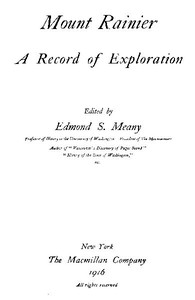
Mount Rainier, a Record of Exploration — Story, Setting & Ideas
(0 User reviews)
781
Project Gutenberg
2013
Not confirmed
Rainier, Mount (Wash.); Mount Rainier National Park (Wash.); Glaciers -- Washington (State) -- Rainier, Mount; Plants -- Washington (State) -- Rainier, Mount
Readers of public-domain and historical texts
Project Gutenberg digital edition
en
Edition facts
Words
109,930
Reading time
478 min
Text sections
12
This digital edition of Mount Rainier, a Record of Exploration — Story, Setting & Ideas is described by source-level measurements including 109,930 words, 7 hr 58 min estimated reading time, and 12 detected text sections.
The text analysis averages about 19.0 words per sentence, while the detected sections provide another way to judge how the source is divided.
Project Gutenberg metadata also associates the work with “Rainier, Mount (Wash.),” connecting these edition facts with the source record’s subject description.
Source:
Project Gutenberg record #42314
A curated anthology of firsthand accounts, scientific reports, and historical documents tracing the discovery, naming, and exploration of Mount Rainier, compiled by historian Edmond S. Meany. The excerpts reveal a focus on glacial geology, place-name origins, and the mountain's physical challenges, with less emphasis on the catalog subject of plants.
Editorial Edition Score
4.9/5
★★★★★
★★★★★
Calculated from edition completeness, EPUB availability, text structure and catalogue metadata. Not a user rating.
How this score is calculated
- Description quality20 pts
- Title & short description10 pts
- Source metadata20 pts
- Text length15 pts
- Chapters / structure15 pts
- EPUB file integrity20 pts
Total of 100 points, scaled to a 2.5-5.0 range. Editions with an empty description or a missing EPUB file are not scored.
Edition quality
Read the Text
ow reached the Smalocho,[8] which runs to the westward, and is sixty-five feet wide: its depth was found to be four and a half feet, which, as it was also rapid, was too great for the horses to ford and carry their loads. The Indians now became serviceable to them. Lieutenant Johnson had engaged several that were met on their way, and they now amounted to thirteen, who appeared for a time lively and contented. This, however, was but a forerunner of discontent, and a refusal to go any farther; but with coaxing and threatening they were induced to proceed.
The road or way, after passing the river, was over a succession of deep valleys and hills, so steep that it was difficult for a horse to get up and over them with a load, and the fall of a horse became a common occurrence. They were all, however, recovered without injury, although one of them fell upwards of one hundred feet; yet in consequence of his fall having been repeatedly broken by the shrubs and trees, he reached the bottom without injury to himself, but with the loss of his load, consisting of their camp utensils, &c., which were swept off by the rapid current of the river.
The route lay, for several days, through forests of spruce, and some of the trees that had fallen measured two hundred and sixty-five feet in length. One of these, at the height of ten feet from the roots, measured thirty-five feet in circumference, and at the end which had been broken off in its fall, it was found to be eighteen inches in diameter, which would make the tree little short of three hundred feet when it was growing. The stems of all these trees were clear of branches to the height of one hundred and fifty feet from the ground, and perfectly straight. In many cases it was impossible to see over the fallen trees, even when on horseback, and on these, seedlings were growing luxuriantly, forcing their roots through the bark and over the body of the trunk till they reached the ground. Many spruces were seen which had grown in this way; and these, though of considerable size, still retained the form of an arch, showing where the old tree had lain, and under which they occasionally rode. As may be supposed, they could not advance very rapidly over such ground, and Lieutenant Johnson remarks, that although he was frequently desirous of shortening the road, by taking what seemed a more direct course, he invariably found himself obliged to return to the Indian trail.
Daylight of the 24th brought with it its troubles: it was found that the horses had strayed,--a disaster that the Indians took quite coolly, hoping it would be the cause of their return. After a diligent search, the horses were found in places where they had sought better food, although it was scanty enough even there.
During the day, the route led along the Smalocho,[9] which runs nearly east and west; and they only left its banks when they were obliged to do so by various impassable barriers. This part of the country is composed of conical hills, which are all thickly clothed with pine trees of gigantic dimensions. They made nine miles this day, without accident; but when they encamped, they had no food for the horses except fern. The animals, in consequence, seemed much overcome, as did also the Indians, who had travelled the whole day with heavy loads. Lieutenant Johnson, by way of diverting the fatigue of the latter, got up a shooting-match for a knife, the excitement of which had the desired effect.
The trees hereabout were chiefly the cotton-wood, maple, spruce, pine, and elder, and some undergrowth of raspberry, the young shoots of which the natives eat with great relish.
On the 25th, they set out at an early hour, and found the travelling less rough, so that they reached the foot of La Tête[10] before noon, having accomplished eleven miles. Lieutenant Johnson with the sergeant ascended La Tête, obtained the bearings, from its summit, of all the objects around, and made its height by barometer, two thousand seven hundred and ninety-eight feet: its latitude was fixed at 47° 08' 54'' N. This mountain was entirely destitute of wood; but, having been burnt over, was found strewn with huge charred trunks, and the whole ground covered with ashes. The inclination of its sides was about fifty degrees.
This volume, edited by University of Washington historian Edmond S. Meany, assembles primary sources that document the human encounter with Mount Rainier from its 1792 sighting by Captain George Vancouver through early twentieth-century scientific expeditions. The preface explains that the book originated from campfire readings during a 1915 circumnavigation by The Mountaineers club, giving the collection an unusual blend of scholarly intent and recreational context. While the catalog lists plants as a subject, the excerpts focus overwhelmingly on glacial movement, rock composition, and the logistics of alpine travel. Readers expecting botanical descriptions will instead find detailed accounts of granite debris, moraines, and the mechanics of ice flow.
Glacial Evidence and Granite Debris
The excerpts devote considerable attention to the physical traces of glaciation. One passage describes how granite pebbles found far down the Carbon and White rivers originate from the high glaciers, where granitic debris is "carried away as moraines and later worked over into well-rounded bowlders." Another notes that the area between the Carbon and Winthrop glaciers is composed of light-colored granite, which forms the border of the valley. These observations are not merely descriptive; they serve as evidence for the geological processes that shaped the mountain's lower valleys. The text treats the landscape as a readable archive of ice movement, with each rock type and landform—such as Moraine Park—offering clues to past glaciation.
The Ascent Narrative: Rope, Crevasses, and Campfires
A first-person account of a 1915 summit attempt provides the most vivid section. The party of five carried "a rope 100 feet long to serve as a life line," alpenstocks, and an alcohol lamp. Their route up Winthrop Glacier grew steeper, with snow "firm and, except for the numerous crevasses, presented no great difficulties." The narrative is punctuated by specific obstacles: a blocked passage between two shattered domes of névé, and a camp at 8,000 feet where balsam boughs made beds and marmots "frequently awakened the echoes with their shrill, whistling cries." The writing balances technical detail—describing how crevasses radiate from rock bosses beneath the ice—with the sensory texture of alpine camping.
Place Names and Naming Controversies
The preface and editorial notes reveal that the book was partly motivated by a desire to document the origin of place names, many of which had never been published. Meany acknowledges that several writers in the collection use the name "Tacoma" rather than Rainier, a reflection of the ongoing dispute over the mountain's official name. The editor does not suppress these variations but lets them stand, allowing readers to see the historical contest over nomenclature. This editorial choice turns the volume into a record not just of exploration but of how explorers argued about what to call what they found. The dedication to General Hazard Stevens, an "early lover of the mountain," further personalizes the naming history.
Readers should approach this collection as a mosaic of voices rather than a unified narrative. The excerpts are strongest on glacial geology and expedition logistics; those seeking systematic botanical or zoological data will need to look elsewhere. The book rewards attention to its editorial framing—the preface, dedications, and headnotes—which reveal as much about early twentieth-century conservation and mountaineering culture as the primary sources themselves.
The rain blurred the windows that afternoon while I traced Meany’s glacier routes, the mountain’s edges softened by cloud. One footnote lingered: a botanist’s lament that snow hid the meadows. Later, flipping pages absently, I landed on The language of flowers — Story, Setting & Ideas, and somehow the silence of that summit became a garden’s quiet reckoning.
There are no reviews for this eBook.
There are no comments for this eBook.
Reader reflection
Before you leave, reflect on the book
Use these questions to collect your thoughts before moving on.
Your progress
0
/
10
2
How much did you enjoy the reading experience?
3
How likely are you to recommend this book?
4
How easy was the book to follow?
5
Did any part of the book feel personally relevant?
6
Do you expect to return to this book?
7
Did you gain anything practical from the text?
8
How did the reading compare with what you expected?
9
In one sentence, what did you learn?
10