1

Flowers of the Southwest Deserts — Story, Setting & Ideas
(0 User reviews)
1764
Project Gutenberg
2016
Not confirmed
Flowers -- Southwest, New; Desert plants
Readers of public-domain and historical texts
Project Gutenberg digital edition
en
Edition facts
Words
25,492
Reading time
111 min
Text sections
6
The catalog record for Flowers of the Southwest Deserts — Story, Setting & Ideas provides practical reading context through 25,492 words, 1 hr 51 min estimated reading time, and 6 detected text sections.
The text analysis averages about 19.0 words per sentence, while the detected sections provide another way to judge how the source is divided.
Project Gutenberg metadata also associates the work with “Flowers -- Southwest, New,” connecting these edition facts with the source record’s subject description.
Source:
Project Gutenberg record #53432
This editorial note examines how Natt N. Dodge's field guide uses structure, recurring imagery, and movement between desert scenes to present over 100 Southwest desert plants, with precise observations drawn from the text's organization and language.
Editorial Edition Score
4.7/5
★★★★★
★★★★★
Calculated from edition completeness, EPUB availability, text structure and catalogue metadata. Not a user rating.
How this score is calculated
- Description quality20 pts
- Title & short description10 pts
- Source metadata20 pts
- Text length15 pts
- Chapters / structure15 pts
- EPUB file integrity20 pts
Total of 100 points, scaled to a 2.5-5.0 range. Editions with an empty description or a missing EPUB file are not scored.
Edition quality
Read the Text
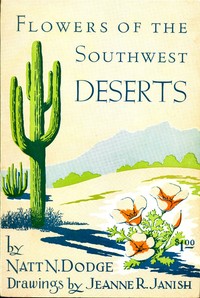
FLOWERS _OF THE_ SOUTHWEST DESERTS
By Natt N. Dodge Drawings by Jeanne R. Janish
SOUTHWESTERN MONUMENTS ASSOCIATION POPULAR SERIES NO. 4
_Copyright 1951, 1952, 1954 by the Southwestern Monuments Association_
U. S. Department of the Interior National Park Service Southwestern National Monuments Gila Pueblo, Globe, Arizona
This booklet is published by the Southwestern Monuments Association in keeping with one of its objectives, to provide accurate and authentic information about the Southwest.
Other numbers of the Popular Series now in print are: (2) “Arizona’s National Monuments,” 1946; (3) “Poisonous Dwellers of the Desert,” in its fourth printing, 1951; (5) “Flowers of the Southwest Mesas,” 1951; (6) “Tumacacori’s Yesterdays,” 1951; (7) “Flowers of the Southwest Mountains,” 1952; and (8) “Animals of the Southwest Deserts,” April, 1954.
A Technical Series will embody results of research accomplished by the staff and friends of Southwestern National Monuments.
Notification of publications by the Association will be given upon date of release to such persons or institutions as submit their names to the Executive Secretary for this purpose.
Dale Stuart King, _Executive Secretary_ Harry B. Boatright, _Treasurer_
John M. Davis, General Superintendent, Southwestern National Monuments, National Park Service, Gila Pueblo, Globe, Arizona, _Chairman_ Horace M. Albright, New York City. Adrey E. Borell, Oklahoma City, Oklahoma. Dr. Harold S. Colton, Flagstaff, Arizona. Dr. Emil W. Haury, Tucson, Arizona. Rev. Victor R. Stoner, Victoria, Texas. Alexander V. Wasson, Santa Fe, New Mexico. Executive Secretary _and_ Treasurer, _ex-officio_
DALE STUART KING, Editor Naturalist, Southwestern National Monuments
First Edition, 5,000 copies, published April 9, 1951 Second edition, revised, of 7,500 copies, January, 1952 Third edition, revised, of 10,000 copies, March, 1954
Printed in the United States of America by Rydal Press, Santa Fe, N.M.
_1. Big Bend National Park_ _2. Carlsbad Caverns National Park_ _3. Casa Grande National Monument_ _4. Chiricahua_ “ “ _5. Death Valley_ “ “ _6. Joshua Tree_ “ “ _7. Montezuma Castle_ “ “ _8. Organ Pipe Cactus_ “ “ _9. Saguaro_ “ “ _10. Tonto_ “ “ _11. Tumacacori_ “ “ _12. White Sands_ “ “ _13. Lake Mead Nat’l Recreation Area_
Desert Areas of the West—this booklet deals with the common plants of three of them: (1) the Chihuahua; (2) the Sonoran; and (3) the Mojave.
Plants of the higher plateau country of from 4,500 to 7,000-feet elevation are shown and described in “Flowers of the Southwest Mesas,” companion volume to this one, by Pauline M. Patraw and Jeanne R. Janish, 1951.
Mountain zone vegetation (from the Ponderosa Pine belt, or about 7,000 feet, on up) is the subject of “Flowers of the Southwest Mountains,” the third of the triad, by Leslie P. Arnberger and Jeanne R. Janish.
FLOWERS OF THE SOUTHWEST DESERTS
By Natt N. Dodge Drawings by Jeanne R. Janish
HOW TO USE THIS BOOKLET
In order that you may get full value from this booklet, it is important that you understand how to make the greatest use of it. The purpose of the booklet is double: (1) to introduce the common desert flowers to newcomers to the Southwest; and (2), to give a little background of information about the plants’ interesting habits and how they have been and are used by animals, by the native peoples, and by the settlers. Every effort has been made to present accurate, if not always complete, information.
Since there are more than 3,200 plants recorded from Arizona alone, and this booklet attempts to introduce you to the common plants of desert areas in Texas, New Mexico, and California in addition to Arizona, it is apparent that you will find an enormous number of flowers which are not included. Therefore, a painstaking effort has been made to select the commonest or most spectacular; that is, those which you will naturally stop to look at and say, “Who are you?”
For ease in identification, flowers are arranged in this booklet according to color of the flower petals. When you meet a flower to whom you would like an introduction, first note the color of its petals. Don’t jump too quickly to a conclusion, for what at first glance may seem to be pink, careful examination may prove to be lavender, violet, or purple. Once you feel reasonably sure of the color, turn to the section of the booklet in which flowers of that color are listed and examine the sketches. Find something that looks similar?
Natt N. Dodge’s Flowers of the Southwest Deserts organizes its plant entries not by scientific taxonomy but by flower color—a deliberate structural choice that prioritizes visual identification over botanical hierarchy. Each entry pairs a common name, scientific name, and range with a concise description that often notes the plant’s behavior in its environment, such as the Desert-mariposa’s habit of “forcing its way up through the low branches” when growing beneath taller shrubs. The book’s movement between scenes—from sandy washes to rocky slopes—mirrors the desert’s own patchwork of microhabitats, while recurring images like “a cloth of gold” for Goldpoppies or “cheesy odor” for Burrobush anchor the reader in sensory detail.
Color as a Structural Principle
Dodge abandons the traditional family-by-family arrangement in favor of grouping plants by blossom color—Orange, Red, Yellow, White, Blue, and so on. This choice reflects the practical needs of a field guide: a hiker encountering a flower can flip to the matching color section without knowing its genus. The excerpts show entries for Orange flowers (Goldpoppy, Devil’s Claw) and Red flowers (Ocotillo), each with a color header that doubles as a visual cue. The structure implicitly acknowledges that desert blooms are often fleeting and seasonally concentrated, so quick identification matters more than taxonomic precision. Within each color group, entries are ordered alphabetically by common name, a simple but effective system that avoids the confusion of shifting between Latin names.
Recurring Images of Abundance and Adaptation
Dodge frequently describes plants in terms of mass effect: Goldpoppies “cover portions of the desert with ‘a cloth of gold,’” while Mariposa lilies “present a gorgeous display of spring color.” These images emphasize the desert’s capacity for sudden, overwhelming bloom after rain. At the same time, the text highlights adaptive details: the Devil’s Claw pod “hooks about the fetlocks of burros or the fleece of sheep” to scatter seeds, and the Desert-mariposa alters its stem length when shaded. The language moves between the spectacular and the mechanical, reminding readers that desert flowers are both beautiful and ruthlessly functional. The repeated mention of elevation limits—such as “below 5,000 feet” for the Mariposa—reinforces the idea that each plant occupies a precise niche.
Movement Between Habitats
The book’s entries trace a clear geographic arc across the three deserts it covers: Chihuahuan, Sonoran, and Mojave. A plant like Burrobush is described as “widespread, and abundant in sandy washes, where it tends to form thickets,” while Ocotillo appears on rocky slopes. This movement is not merely descriptive; it guides the reader’s eye from low washes to higher ground, from coarse sand to gravelly soil. The text often notes where species overlap or diverge—for instance, the Goldpoppy has separate species for Arizona (Eschscholtzia mexicana) and California (E. glyptosperma), each with slightly different bloom times. By linking each plant to a specific terrain, Dodge creates a mental map of the desert as a mosaic of distinct zones.
The Role of the Illustrations
Jeanne R. Janish’s drawings are integral to the book’s structure, though the excerpts provide only captions and references. The text frequently directs attention to visual details that the drawings presumably capture: the “large, black, woody pods” of Devil’s Claw, the “silvery red” bracts of Burrobush, the “orange” petals of the Goldpoppy. Dodge’s prose often describes what the eye should see, as in the note that the small-flowered Devil’s Claw has blossoms “reddish purple to white streaked with orange and yellow.” This coordination between word and image suggests that the book was designed for side-by-side use in the field. The drawings likely serve as the primary identification tool, with the text providing context on range, season, and ecological quirks.
Readers will find that Flowers of the Southwest Deserts rewards attention to its small structural details—the color groupings, the habitat notes, the recurring emphasis on how plants move and spread. The book is best used as a companion on walks through the Chihuahuan, Sonoran, or Mojave deserts, where its concise entries can be matched to living specimens. Dodge’s focus on observable traits rather than botanical theory makes the guide accessible, while his precise language ensures that even armchair readers can picture the desert in bloom.
Sitting with Flowers of the Southwest Deserts, I remembered my father’s worn copy of a field guide we used on slow walks—how the same plant could feel entirely new each time we paused. That patient turning of pages, searching for one name, reminded me of an old volume on Ginseng and Other Medicinal Plants A Book of Valuable Information for Growers as Well as Collectors of Medicinal Roots, Barks, Leaves, Etc. — Context and Discussion, where roots held quiet histories beneath the soil.
There are no reviews for this eBook.
There are no comments for this eBook.
Reader reflection
How will you remember this book?
Save your reaction, strongest insight, and memorable passage.
Your progress
0
/
10
2
Did this book hold your interest?
3
How likely are you to recommend this book?
4
How demanding did the text feel?
5
Was the book what you thought it would be?
6
What did you appreciate most?
7
How valuable was this book for your own interests?
8
Did any part of the book feel personally relevant?
9
What did this book teach you most?
10