1

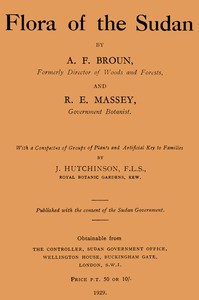
Flora of the Sudan — Text and Context
(0 User reviews)
127
Project Gutenberg
2025
Not confirmed
Plants -- Sudan; Plant names, Popular -- Sudan
Readers of public-domain and historical texts
Project Gutenberg digital edition
en
Edition facts
Words
165,559
Reading time
720 min
Text sections
30
Flora of the Sudan — Text and Context can be approached with a clearer sense of reading commitment from its source measurements: 165,559 words, 12 hr estimated reading time, and 30 detected text sections.
The text analysis averages about 7.4 words per sentence, while the detected sections provide another way to judge how the source is divided.
Project Gutenberg metadata also associates the work with “Plants -- Sudan,” connecting these edition facts with the source record’s subject description.
Source:
Project Gutenberg record #75659
A 1929 botanical reference by A. F. Broun and R. E. Massey, cataloging Sudan's flowering plants with scientific descriptions, vernacular names in over a dozen languages, and economic uses, reflecting colonial-era fieldwork and indigenous knowledge.
Editorial Edition Score
4.9/5
★★★★★
★★★★★
Calculated from edition completeness, EPUB availability, text structure and catalogue metadata. Not a user rating.
How this score is calculated
- Description quality20 pts
- Title & short description10 pts
- Source metadata20 pts
- Text length15 pts
- Chapters / structure15 pts
- EPUB file integrity20 pts
Total of 100 points, scaled to a 2.5-5.0 range. Editions with an empty description or a missing EPUB file are not scored.
Edition quality
Read the Text
ed, up to 2 in. long. Male flowers in short spikes or racemes; drupes solitary, size of a walnut.
Fung, Nuba Mts. & Bahr El Ghazal Provinces; Upper White Nile Prov. (Goz El Siada); Mongalla Prov.
The wood is used for making vessels for holding food.
405 =Byrsocarpus pseudobaccatus= _Schellenb._
Tree 20 ft. high. Leaves pinnate; leaflets elliptic to obovate, obtuse, 3-4 in. long, 1½-2 in. broad, glabrous. Racemes in dense fascicles. Fruit curved, ¾ in. long.
Bahr El Ghazal Prov. (Niamniam-land).
405a =Rourea gudjuana= _Gilg._
Shrub. Leaves pinnate; leaflets ovate or ovate-lanceolate, obtusely acuminate, 2½-4 in. long, ¾-1½ in. broad, reticulate. Racemes densely fasciculate, axillary. Fruits ovoid-lanceolate, acute, ½ in. long.
Bahr El Ghazal Prov. (Dar Fertit: Deim Gudju).
406 =Agelæa Schweinfurthii= _Gilg._
Shrub, 8 ft. high. Leaves pinnate; leaflets ovate-elliptic, shortly acuminate, about 3½ in. long and 2 in. broad, glabrous. Flowers in terminal panicles. Fruit obliquely obovoid, tomentellous, ½ in. long.
Belgian Congo (Niamniam-land: by the Diagbe River).
407 =Cnestis cf. C. oblongifolia= _Baker._
Woody climber. Flowers white, without smell; fruit orange, acid. Leaves imparipinnate.
Bahr El Ghazal Prov. (Niamniam-land: Nabambisso River). Fruit orange- acid.
408 =Hydrocotyle asiatica= _Linn._
Perennial herb giving out long runners from axils of leaves on root- stock. Leaves from root-stock or 1 or 2 together from nodes of runners, reniform, shallowly crenate. Flowers subsessile, usually 3 together at end of short erect peduncles, pink. Peduncles 1-3 from nodes opposite the leaves. Fruit ovoid, hard with primary and secondary ribs obscure.
Bahr El Ghazal Prov. (Niamniam-land: Tuhami’s Zeriba).
Creeping perennial, rooting at nodes. Leaves long-petioled, suborbicular, shallow-crenate, subpeltate. Umbels ab. 7 flowered. Fruit minute, longitudinally ridged.
Bahr El Zeraf; Bahr El Jebel (Sudd to Bor).
409 =Pimpinella etbaica= _Schwfth._
Annual up to 1 ft. high. Leaves, the lower long petioled, pinnately tripartite, the upper variously trifid. Umbels compound, primary rays 3-7, secondary 7-12, involucres absent. Flowers white or violet; fruit covered with hooked hairs.
Red Sea Prov. (above 2,000 ft.).
410 =Diplolophium abyssinicum= _Benth._ & _Hook. f._
Perennial 2-5 ft. high, sometimes perfumed like peppermint. Leaves up to 1 ft. and more long, many times divided, segments filiform; petioles up to 5 in. long, sheathing. Umbels compound, primary rays numerous from an involucre of stout 1 in. long, pubescent bracts; secondary rays numerous, from involucels of ab. ½ in. long bracteoles. Flowers comparatively large, hermaphrodite. Petals emarginate. Fruit cylindrical with 2 long styles.
Fung Prov. (Fazoghli); Upper White Nile Prov.; Bahr El Ghazal Prov. (Niamniam-land: steppes near the Kishi River); Darfur Prov. (Jebel Marra, 8,000 ft.).
411 =Fœniculum vulgare= _Gærth._ Common Fennel.
Herb 2-3 ft. high. Leaves 3-4 times pinnate; segments narrow, linear. Umbels compound, without involucres, 15-20 rays in umbel. Fruit ¼ in. long, oval, slightly compressed laterally; vittæ conspicuous under the furrows.
Darfur Prov. (J. Marra, 5-9,000 ft.).
412 =Sium Thunbergii= _DC._ Prod.
Marsh herb, with runners. Leaves pinnate, dentate, 1 ft. long, with sheathing, auricled petiole 5 in. long. Umbels compound; rays numerous with many-leaved involucres and involucels. Fruit shortly ovoid, compressed.
Darfur Prov. (J. Marra: Niurnya 6,500 ft.).
=S. angustifolium= _Linn._
Perennial up to 2 ft. high. Leaves pinnate; segments of lower leaves 8-10 pairs and an odd one, ovate-lanceolate, serrate; upper leaves, segments less numerous, but larger and more deeply toothed or lobed. Umbels compound with primary and secondary involucres, lateral; carpels with 5 slender ribs and several vittæ.
Darfur Prov. (J. Marra: Niurnya 6,500 ft.).
413 =Peucedanum Grantii= _Kingston._
Stout glabrous herb up to 7 ft. high. Lower leaves bipinnate, upper ternate, on dilated petioles. Umbels compound, paniculate on a distinct peduncle; primary rays numerous with no involucre or only 1 small bract; secondary numerous; involucel of several bracteoles. Fruit ⅓ in. long, with 3 longitudinal ridges.
=P. graveolens= _Benth._ & _Hook. f._ The Dill Plant.
Erect, glabrous annual, 1-2 ft. high. Leaves much divided; segments linear-bristly. Umbels compound, many-rayed. Involucre and involucels none. Flowers yellow. Fruit 1/5 in. oval oblong, compressed, ridged, with lateral wings.
=P. fraxinifolium= _Hiern._ ASAD EL TUGULE & ASAT EL GIRD (Baggara)—Arab; DAHKIKAK (J. Daier), KOTUNDURAK (J. Eliri) & N’DARABWA (Kadugli)—Nuba.
Small fleshy tree. Leaves pinnate; leaflets 9. Umbels compound, arranged together, on about ½ a dozen 5 in. long peduncles at end of branches. Fruit obovate, broadly winged.
Nuba Mts. Prov. (on rocks); Bahr El Jebel (Madi); Belgian Congo (Niamniam-land: Wando’s country).
414 =Coriandrum sativum= _Linn._ Common Coriander.
Erect branching annual up to 18 in. high. Lower leaves pinnatifid or bipinnatifid; upper leaves much divided with linear segments. Umbels terminal, of 5-8 rays. Involucre none, involucels of few bracts. Fruit globose, ribs not very prominent, vittæ none.
Darfur Prov. (J. Marra: Niurnya 6,500 ft.).
415 =Blæria spicata= _Hochst._
Heath-like low shrub. Leaves alt., or more commonly 3 whorled, linear to lanceolate, revolute. Fl. up to ¼ in. long, pink, in leafy racemes from upper axils, 4-merous; anthers 4, 2-lobed, opening by terminal pores and with 2 short basal bristles. Capsule 4-valved.
Darfur Prov. (J. Marra, 8,500-9,000 ft.).
416 =Euclea Kellau= _Hochst._ GUM or OGUM—Hadendowa.
This 1929 volume opens with a preface tracing its origins to a 1901 forest report and the authors' own collecting journeys across Sudan. Broun and Massey, a former Director of Woods and Forests and a Government Botanist, explicitly acknowledge contributions from local officials and from their wives, who helped record plant names in languages such as Arabic, Nuba, Dinka, Bari, Golo, and Zande. The work is not a complete flora but a systematic enumeration of families, genera, and species, preceded by a conspectus of plant groups and an artificial key to families contributed by J. Hutchinson of Kew.
A Collaborative Catalog of Vernacular Names
The preface and species entries reveal a layered process of naming. Broun notes that his wife and he collected plants while making notes of their names in various languages. The resulting indexes list native names in sixteen languages or dialects, including Hadendowa, Rashida, Jur, Golo, Bari, Hameg, Nuer, Shilluk, Burun, Bongo, Zande, Krej, Indogo, Tuku-Tuku, Kaliko, and Makraka. For example, the species Gardenia lutea is recorded with Arabic names (Abbaka, Abu Gawi, Baggis), a Nuba name (Magal), a Bongo name (Kugo), Dinka names (Daung, Dong, Adong, Dunk), a Bari name (Dufiti), a Golo name (Aklímbo or Chii), a Hameg name (Runda), a Jur name (Adwang), and a Zande name (M’Begge). This multiplicity suggests the compilers relied on local informants and earlier lists, such as Muriel's 1901 report, which gave Arabic and Hameg names for common trees.
Economic Botany and Indigenous Uses
Many entries include practical applications drawn from observation or from Watt's Dictionary of Economic Products. For Gardenia lutea, the roots boiled with dura flour are taken as a cure for blackwater fever; the wood is used for knife handles; the plant yields a fragrant resin called Abu Beka; and the fruit serves as a fish poison. Gardenia Vogelii produces a blue-black dye used by the Azande for staining their faces. Feretia apodanthera fruit can substitute for coffee. These notes are terse but reveal a colonial botany that systematically recorded indigenous plant use alongside Linnaean classification. The preface acknowledges help from Watt's dictionary, but the specific local applications—such as the Azande face-staining—appear to come from direct observation or informant reports.
Geographic and Ecological Specificity
Species entries consistently cite provinces and sometimes river systems or landmarks. Gardenia lutea is recorded from Kassala, Fung, White Nile, and Bahr El Ghazal Provinces, south of latitude 13° N. Gardenia urcelliformis is noted from Bahr El Ghazal Province, Niamniam-land, by the Nabambisso River. Amaralia heinsioides is listed from the Belgian Congo, Niamniam-land, by the Diamvonu River—a rare cross-border record. The preface explains that Broun's travels covered various parts of the Sudan, and he also consulted the Kew Herbarium. The geographic range statements, such as "South of Lat. 13° N." for G. lutea, suggest an attempt to delimit distributions, though the entries are too brief to constitute a full phytogeography.
Readers approaching this flora should note its dual character: it is both a scientific enumeration and a record of vernacular knowledge, shaped by the constraints of colonial administration. The entries are concise, often omitting full descriptions of habit or habitat, but the inclusion of multiple native names and local uses makes it a valuable source for ethnobotanical and historical linguistic study. The keys by Hutchinson provide a technical entry point, while the indexes allow cross-referencing by language.
I keep coming back to that old Flora of the Sudan, struck by how patiently its authors recorded each plant’s local names alongside the Latin. There’s a tenderness in that, a willingness to listen. It reminds me of another quiet classic, A Handbook of Some South Indian Grasses — Inside the Classic, where even the humblest blade gets its due attention. I wonder if we still have that kind of patience.
There are no reviews for this eBook.
There are no comments for this eBook.
Reader reflection
How did this book work for you?
Your answers remain private and are stored only in this browser.
Your progress
0
/
10
2
Was reading this book enjoyable?
3
Would you encourage someone else to read it?
4
How easy was the book to follow?
5
How personally connected did you feel to the book?
6
Which part made the strongest impression?
7
How valuable was this book for your own interests?
8
Did the book meet your expectations?
9
Which lesson or insight stayed with you?
10