1

Drug Plants Under Cultivation — Themes and Context
(0 User reviews)
36
Project Gutenberg
2020
Not confirmed
Botany, Medical; Medicinal plants -- Culture -- United States
Readers of public-domain and historical texts
Project Gutenberg digital edition
en
Edition facts
Words
29,721
Reading time
130 min
Text sections
4
This digital edition of Drug Plants Under Cultivation — Themes and Context is described by source-level measurements including 29,721 words, 2 hr 10 min estimated reading time, and 4 detected text sections.
The text analysis averages about 22.2 words per sentence, while the detected sections provide another way to judge how the source is divided.
Project Gutenberg metadata also associates the work with “Botany, Medical,” connecting these edition facts with the source record’s subject description.
Source:
Project Gutenberg record #62715
This editorial note examines the language and narrative voice in W. W. Stockberger's 1915 USDA bulletin on cultivating medicinal plants, focusing on its pragmatic tone, shifts between general advice and species-specific instructions, and the recurring emphasis on economic risk.
Editorial Edition Score
4.6/5
★★★★★
★★★★★
Calculated from edition completeness, EPUB availability, text structure and catalogue metadata. Not a user rating.
How this score is calculated
- Description quality20 pts
- Title & short description10 pts
- Source metadata20 pts
- Text length15 pts
- Chapters / structure15 pts
- EPUB file integrity20 pts
Total of 100 points, scaled to a 2.5-5.0 range. Editions with an empty description or a missing EPUB file are not scored.
Edition quality
Read the Text
Text emphasis denoted as _Italic_ and =Bold=.
FARMERS' BULLETIN 663
UNITED STATES DEPARTMENT OF AGRICULTURE
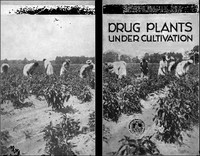
DRUG PLANTS UNDER CULTIVATION
This Bulletin gives general suggestions relative to the culture, harvesting, distillation, yield, marketing, and commercial prospects for drug plants. Specific information is also given concerning the cultivation, handling, and yield of individual species and the demand and prices paid for the product.
The market demand for many cultivated plant drugs is not large enough to justify growing them except as small minor crops.
The haphazard production of crude drugs in small lots of a few pounds usually means a dissatisfied producer.
A special knowledge of trade requirements is necessary in collecting, curing, preserving, and packing drugs for market.
Most farm products find a ready local market; a special market must be sought for plant drugs.
High prices for plant drugs do not insure large profits in producing them. Not the price received, but the difference between the cost of production and the selling price is the important point.
Contribution from the Bureau of Plant Industry
Issued, June, 1915 Washington, D. C. Revised, August, 1920
Show this bulletin to a neighbor. Additional copies may be obtained free from the Division of Publications, United States Department of Agriculture.
DRUG PLANTS UNDER CULTIVATION.
W. W. Stockberger, _Physiologist in Charge, Drug, Poisonous, and Oil Plant Investigations_.
Production of crude drugs 3
Some drug plants suitable for cultivation in the United States 4
General cultural suggestions 5
Commercial prospects 12
The cultivation and handling of drug plants 14
PRODUCTION OF CRUDE DRUGS.
Interest in the possibility of deriving profit from the growing of drug plants is increasing yearly. The clearing of forests, the extension of the areas of land under tillage, and the activities of drug collectors threaten the extermination of a number of valuable native drug plants. Annually, large sums of money are expended for crude drugs imported from countries where they are grown under conditions of soil and climate resembling those of many localities in the United States. As a means of guaranteeing the future supply of crude drugs and of lessening the dependence on importations, attention is now being turned to the cultivation of drug plants with a view to increasing domestic production.
The problems presented by the cultivation of drug plants are not less difficult than those encountered in the production of many other crops. Drug plants are subject to the same diseases and risks as other crops and are similarly affected by variations in soil and climatic conditions. They require a considerable outlay of labor, the same as other crops, and likewise require intelligent care and handling. They are subject to the same laws of supply and demand, and, like other products, must conform to the consumer's fancy and to definite trade requirements.
A number of common medicinal plants have long been cultivated in gardens in this country, either as ornamentals or as a source of herbs used in cookery and as domestic remedies. A few of these plants, such as goldenseal, wormwood, wormseed, and peppermint, have been grown commercially for sale as crude drugs; but the acreage devoted to their production has been relatively small and for the most part restricted to certain localities. Other drug plants which occur as common weeds in many places may prove to respond to cultivation; experiments should then be undertaken to determine whether it is profitable to grow them. In this connection it should be remembered that the soil type very often is an important limiting factor in propagating different kinds of plants. Some plants grow best in well-drained loam, some prefer a marsh, some require soils rich in lime, while others thrive only in acid soil. The soil requirements of all plants are not understood; in fact it is not improbable that better comprehension of the soil, climatic, and cultural conditions adapted to the different kinds of plants will enable the successful propagation of species now regarded as unsuited to cultivation. In undertaking the growing of medicinal plants, therefore, it is essential to know that the species selected for cultivation will do well under the conditions of soil and climate existing where the planting is to be made. When necessary, this should be determined on small experimental plats before undertaking commercial plantings.
W. W. Stockberger’s Drug Plants Under Cultivation opens with a blunt warning: “High prices for plant drugs do not insure large profits.” This sentence sets the tone for a bulletin that is less a horticultural guide and more a cautionary business manual. The language throughout is direct and unadorned, favoring concrete figures—pounds, cents, acres—over botanical description. Stockberger’s voice shifts between the general and the specific, moving from broad economic principles to precise cultivation steps for individual species. The narrative pace is deliberate, often pausing to underscore risk before proceeding to method.
A Voice of Caution and Calculation
The bulletin’s opening paragraphs establish a distinctive rhetorical stance: the author repeatedly warns against optimism. Phrases like “haphazard production” and “dissatisfied producer” appear early, framing drug-plant cultivation as a precarious venture. Stockberger’s prose is built on contrasts—between local markets and special markets, between price and profit. He uses short, declarative sentences to drive home economic realities: “Not the price received, but the difference between the cost of production and the selling price is the important point.” This calculated tone persists throughout, even in sections that describe planting depths or drying methods. The effect is a narrative that treats farming as a business equation first, a botanical process second.
Shifts in Pace: From General Principle to Specific Instruction
After the opening cautions, the bulletin shifts into a more methodical rhythm. The section on digitalis, for example, begins with a brief botanical note—foxglove is “a fairly hardy European perennial”—then quickly moves to practical details: seed size, germination difficulties, the need for sand mixing. The pace here is slower, almost procedural, as Stockberger enumerates steps from February seeding to second-year harvest. Yet he interrupts this flow with reminders of economic risk: “the crop occupies the soil for the greater part of two seasons and demands even closer attention than many truck or garden crops.” These interjections create a pattern of tension—technical instruction repeatedly undercut by financial caution. The result is a narrative that never lets the reader forget the stakes.
Recurring Details: Yields, Prices, and the Shadow of Importation
Throughout the excerpts, Stockberger returns to three data points: yield per acre, price per pound, and annual import tonnage. For dandelion root, he notes yields of “1,000 to 1,500 pounds of dry roots per acre” and pre-war prices of “4 to 10 cents a pound.” For digitalis, he cites “450 to 600 pounds of dry leaves per acre” and a price rise from 15 to 35 cents by 1920. These figures are not mere statistics; they anchor the narrative in a specific economic landscape. The repeated mention of importation—dandelion root imports averaging “about 40 tons” annually—reinforces the bulletin’s underlying argument: domestic cultivation is a hedge against foreign dependence. This recurring detail gives the work a geopolitical undertone, linking farm decisions to national supply chains.
Readers approaching Drug Plants Under Cultivation should attend to its dual nature: it is both a technical manual and a piece of economic persuasion. Stockberger’s language rewards attention to shifts in register—from the blunt warnings of the introduction to the measured instructions of the species entries. The bulletin’s value lies not only in its cultivation advice but in its portrait of early twentieth-century agricultural risk. To read it is to hear a government expert trying to temper enthusiasm with hard numbers.
Reading about Stockberger’s warnings on economic risk, I remembered my grandfather’s ledger, where he twice crossed out his ginseng rows. That same patient caution, the gentle insistence on watching rather than forcing, lives in The Movements and Habits of Climbing Plants — Reading Notes. Both books whisper the same quiet truth: plants teach us their pace, if we’re willing to sit still.
There are no reviews for this eBook.
There are no comments for this eBook.
Reader reflection
Your personal reading reflection
Build a private reading journal entry for this title.
Your progress
0
/
10
2
How did the book work for you overall?
3
Would you encourage someone else to read it?
4
What was the reading difficulty like?
5
Did anything about the book feel genuinely new?
6
Did this book create an emotional response?
7
Would a second reading be valuable?
8
How strong was your personal connection to the text?
9
What changed or sharpened your thinking?
10