1

Common poisonous plants of New England — Themes and Context
(0 User reviews)
2425
Project Gutenberg
2023
Not confirmed
Poisonous plants -- New England
Readers of public-domain and historical texts
Project Gutenberg digital edition
en
Edition facts
Words
8,212
Reading time
36 min
Text sections
26
This digital edition of Common poisonous plants of New England — Themes and Context is described by source-level measurements including 8,212 words, 36 min estimated reading time, and 26 detected text sections.
The text analysis averages about 16.4 words per sentence, while the detected sections provide another way to judge how the source is divided.
Project Gutenberg metadata also associates the work with “Poisonous plants -- New England,” connecting these edition facts with the source record’s subject description.
Source:
Project Gutenberg record #71397
This 1964 booklet from the Rhode Island Department of Health catalogs 20 common poisonous plants of New England, with photographs and descriptions. Each entry details the plant's appearance, toxic parts, symptoms, and first aid, emphasizing identification and emergency response.
Editorial Edition Score
4.7/5
★★★★★
★★★★★
Calculated from edition completeness, EPUB availability, text structure and catalogue metadata. Not a user rating.
How this score is calculated
- Description quality20 pts
- Title & short description10 pts
- Source metadata20 pts
- Text length15 pts
- Chapters / structure15 pts
- EPUB file integrity20 pts
Total of 100 points, scaled to a 2.5-5.0 range. Editions with an empty description or a missing EPUB file are not scored.
Edition quality
Read the Text
Underscores “_” before and after a word or phrase indicate _italics_ in the original text. Equal signs “=” before and after a word or phrase indicate =bold= in the original text.
COMMON POISONOUS PLANTS OF NEW ENGLAND
U.S. DEPARTMENT OF HEALTH, EDUCATION, AND WELFARE Public Health Service
This material was prepared by Heber W. Youngken, Jr., Ph. D., Dean of the College of Pharmacy, University of Rhode Island, Kingston; and Joseph S. Karas, M.D., Director of the Poison Control Center at Rhode Island Hospital, Providence, and is published by the Rhode Island Health Department in cooperation with the U.S. Public Health Service, Division of Accident Prevention. The photographs were provided by Dean Youngken.
RHODE ISLAND DEPARTMENT OF HEALTH Division of Health Education and Information and THE UNIVERSITY OF RHODE ISLAND
In Cooperation With U.S. DEPARTMENT OF HEALTH, EDUCATION, AND WELFARE
Public Health Service Division of Accident Prevention Washington, D.C. 20201
Public Health Service Publication No. 1220 April 1964
For sale by the Superintendent of Documents, U.S. Government Printing Office Washington, D.C., 20402
COMMON POISONOUS PLANTS OF NEW ENGLAND
Page Introduction ii Amanita mushroom 1 Baneberry 2 Bittersweet 3 Bloodroot 4 Castor bean 5 Christmas rose 6 Daphne 7 Deadly nightshade 8 Foxglove 9 Green hellebore 10 Indian hemp 11 Jimson weed 12 Larkspur 13 Lily-of-the-valley 14 Monkshood 15 Poison-hemlock 16 Poison-ivy 17 Pokeweed 18 Water hemlock 19 Yew 20 Poison Control Centers 21 Plant Index 23
Prompted by the many telephone calls and inquiries received at the Rhode Island Poison Control and Information Centers regarding plants, flowers, and berries, the State Department of Health has developed the information contained in this booklet. It will aid families in planning safe gardens, give fuller knowledge of wild plants, and, in the case of an accidental ingestion, provide assistance in identifying the plant. Since verbal descriptions are frequently inadequate, and nonprofessional determination of species often uncertain, there has been a need for a more expedient means of identifying plants and their toxicity.
Because the toxicity of these plants will vary with the size of the child, the season, and the quantity and part of the plant eaten, it is necessary that a physician determine the necessary treatment for each case.
=THIS BOOKLET ENCOURAGES THE EMPTYING OF THE STOMACH OF A VICTIM BY VOMITING AS A GENERAL MEASURE IN PREVENTING SERIOUS INJURY.
VOMITING SHOULD NOT BE INDUCED IF THE VICTIM IS UNCONSCIOUS OR CONVULSING.=
Some basic information is included for physicians who might be unaware of the toxic principles and their effects in these particular plants. Although the seriousness of each accident must be judged individually, it is necessary that the plant be accurately identified and that sufficient information on its toxicity be readily available. Many other poisonous plants could have been included in this booklet, but, the purpose was to discuss those found most commonly, although not exclusively, in the New England States.
The names and telephone numbers of the Poison Control Centers in the New England area are included for the convenience of your physician. (See page 21.)
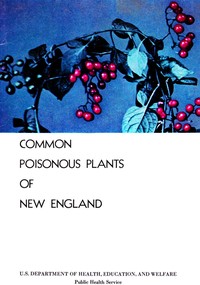
Cover picture: European bittersweet _Solanum dulcamara_ (see page 3)
=Description=: One of the most poisonous of the mushrooms (toadstools). Found mostly in woody areas, along roadsides, and waste places, especially at the base of pine and similar trees. Unlike many edible mushrooms, this poisonous amanita has a fleshy bulb-like base and yellow stalk (stipe) with scaly growths and a cap or top (pileus). Often a white ring (annulus) of soft ragged tissue may be observed on the stalk under its cap. All amanita mushrooms should, in general, be considered poisonous. The top, which may be 3 to 6 inches wide, varies in color from bright orange to red with white to gray warty growths on it. Under the cap are numerous very white gills which distinguish this mushroom from most edible types. The latter usually have pink to purple gills. These mushrooms form in groups, or are scattered.
Other poisonous mushrooms found in New England are the Death Cup, _Amanita phalloides_; jack-o’-lantern, _Clitocybe illudens_; Shaggy mane, _Coprinus comatus_; and the _Boletus_ and _Russula_ species. There are many others. Perhaps the best precaution is to avoid eating any mushroom not certified by an expert to be edible.
=Poisonous Parts=: All portions are poisonous. The chief toxic principle is an alkaloid, =muscarine=. Amanita poisoning is characterized by intense sweating, salivation, wheezing, irregular breathing and heart beat. If not treated promptly, it =can be fatal= within an hour depending upon quantities consumed.
=Antidote=: Call your doctor. Have patient vomit. Physicians perform gastric lavage and treat for =muscarine= alkaloid poisoning or excessive muscarinic stimulation of the parasympathetic nervous system, also dehydration. Atropine and other similar drugs counteract the effects of =muscarine=.
The booklet opens with a practical origin story: it was prompted by telephone calls to the Rhode Island Poison Control and Information Centers. The authors, a pharmacist and a physician, frame the work as a response to a real public need—not a botanical survey but a tool for families and physicians. The language is direct, clinical, and urgent, especially in the capitalized warnings about inducing vomiting. This is not a leisurely field guide; it is a reference meant to be consulted in moments of crisis.
A Clinical Voice in a Botanical Frame
The prose shifts between two registers. The descriptive sections adopt a neutral, observational tone: “Poison-ivy, with its characteristic three-leaf appearance and prominent veins is a woody vine, climbing by aerial rootlets.” But the antidote sections switch to imperative commands: “Call your doctor. Have patient vomit.” This dual voice mirrors the booklet’s dual audience—laypeople who need to identify a plant and physicians who need treatment protocols. The authors do not assume botanical expertise; they describe plants in terms of visible features (leaf shape, berry color, growth habit) rather than technical keys. Yet they also include chemical names like coniine and urushiol, trusting that some readers will recognize them.
Structure as a Safety Net
Each of the 20 entries follows a rigid template: a common name and scientific name, a description of the plant, a list of poisonous parts, symptoms, and an antidote section. This consistency allows a reader to find critical information quickly under stress. The entries are short—typically 150–200 words—and the most urgent warnings are set in all-caps. The booklet also includes a plant index and a list of Poison Control Centers, reinforcing its function as a rapid-reference tool. The structure itself is a form of safety engineering: repetition of format reduces the cognitive load on a panicked caregiver.
Pace and the Weight of History
The pacing is brisk but not rushed. Descriptions move from general appearance to specific toxic parts, then to symptoms and treatment. Occasionally, the authors pause for a historical note: “The poisonous hemlock juice was employed by ancient Greeks as a means of capital punishment. Socrates and other celebrities are said to have met death by this means.” These asides are rare and brief, but they break the clinical rhythm and remind the reader that these plants have long, sometimes infamous, histories. The mention of Socrates is the only historical reference in the excerpts; it appears without elaboration, as if the authors assume the reader knows the story. This single sentence changes the pace, offering a moment of reflection before returning to the urgent business of antidotes.
This booklet is best read not as a continuous narrative but as a set of discrete, urgent entries. Readers should familiarize themselves with the layout—the consistent headings, the capitalized warnings, the index—so that in an emergency they can find information without hesitation. The authors have designed the text for speed and clarity, not for pleasure. Approach it as a tool: learn the structure, and it will serve you when you need it most.
I’ve shelved that 1964 pamphlet on poisonous New England plants for decades, its pages whispering caution. Yet beside it rests American root drugs — Reading Companion, and I’ve grown fond of their quiet duel. One warns against the green, the other praises its healing beneath. Together, they feel like two old friends arguing gently about the same meadow.
There are no reviews for this eBook.
There are no comments for this eBook.
Reader reflection
How will you remember this book?
Save your reaction, strongest insight, and memorable passage.
Your progress
0
/
10
2
How much did you enjoy the reading experience?
3
How likely are you to recommend this book?
4
How much effort did this book require?
5
How useful did the reading feel?
6
How would you describe its reading pace?
7
How clear did the writing feel?
8
How closely did the book connect with your experience?
9
Which lesson or insight stayed with you?
10