1

Botany: The Science of Plant Life — Text and Context
(0 User reviews)
180
Project Gutenberg
2015
Not confirmed
Plants; Botany -- Textbooks
Readers of public-domain and historical texts
Project Gutenberg digital edition
en
Edition facts
Words
104,598
Reading time
455 min
Text sections
13
The catalog record for Botany: The Science of Plant Life — Text and Context provides practical reading context through 104,598 words, 7 hr 35 min estimated reading time, and 13 detected text sections.
The text analysis averages about 23.7 words per sentence, while the detected sections provide another way to judge how the source is divided.
Project Gutenberg metadata also associates the work with “Plants,” connecting these edition facts with the source record’s subject description.
Source:
Project Gutenberg record #49211
Norman Taylor's 1922 botany textbook uses deliberate anthropomorphism to explain plant behavior, emphasizing accessible language over technical jargon. The excerpts show a methodical classification of families like Ericaceae and Lamiaceae, with precise observations on flower structure, ovary position, and pollination.
Editorial Edition Score
4.9/5
★★★★★
★★★★★
Calculated from edition completeness, EPUB availability, text structure and catalogue metadata. Not a user rating.
How this score is calculated
- Description quality20 pts
- Title & short description10 pts
- Source metadata20 pts
- Text length15 pts
- Chapters / structure15 pts
- EPUB file integrity20 pts
Total of 100 points, scaled to a 2.5-5.0 range. Editions with an empty description or a missing EPUB file are not scored.
Edition quality
Read the Text
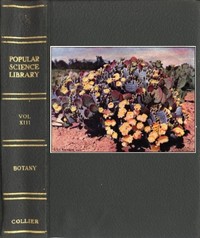
POPULAR SCIENCE LIBRARY
WILLIAM J. MILLER HIPPOLYTE GRUENER A. RUSSELL BOND D. W. HERING LOOMIS HAVEMEYER ERNEST G. MARTIN ARTHUR SELWYN-BROWN ROBERT CHENAULT GIVLER ERNEST INGERSOLL WILFRED MASON BARTON WILLIAM B. SCOTT ERNEST J. STREUBEL NORMAN TAYLOR DAVID TODD CHARLES FITZHUGH TALMAN ROBIN BEACH
ARRANGED IN SIXTEEN VOLUMES WITH A HISTORY OF SCIENCE, GLOSSARIES AND A GENERAL INDEX
P. F. COLLIER & SON COMPANY NEW YORK
Copyright 1922 BY P. F. COLLIER & SON COMPANY
MANUFACTURED IN U. S. A.
THE SCIENCE OF PLANT LIFE
CURATOR, BROOKLYN BOTANIC GARDEN
P. F. COLLIER & SON COMPANY NEW YORK
This book is for those who want some general knowledge of the plant world, without necessarily caring for the technical details upon which such knowledge is based. If it leaves the reader with an impulse to follow the subject further than has been possible here, it will have more than fulfilled its mission.
Throughout the book, it has often been convenient to refer to plants or their behavior in terms implying reasoning faculties. Of course, plants are never reasoning things, reasonable as many of their actions appear to be, and to ascribe such qualities to them is to saddle them with attributes perfectly foreign to the plant world. But the description of them in the terms of our everyday speech, the translation of plant behavior into the current conceptions of mankind, does so fix these in our minds that they cease to be among those interesting things that nearly everyone forgets. I have followed this method deliberately, understanding perfectly the objections to it, but believing, with the late C. E. Bessey, that in popular books “it is an admirable way of looking at some botanical things.”
All of the half-tone illustrations, except two, are from the photographic collections of the Brooklyn Botanic Garden, and I am under the greatest obligation to the director of that institution for permission to publish them here. The illustration of the living and fossil algæ has been taken from Prof. Henry Fairfield Osborn’s “Origin and Evolution of Life,” with his kind permission. The illustration of desert vegetation is from a photograph by the late E. L. Morris, and kindly loaned from the collection of the Brooklyn Museum. All the line cuts in the text are from drawings made specially for this book by my wife, Bertha Fanning Taylor.
While grateful and particular acknowledgments can be made for the illustrations, it is difficult or impossible to properly express my indebtedness to all those who, through their books and pamphlets, have indirectly aided in the making of this book. It would involve the mention of most of the better known writers of the books found in the larger botanical libraries. It is a pleasure to acknowledge help from Dr. M. A. Howe of the New York Botanical Garden on the literature of fossil and hot-spring algæ, and from Dr. Orland E. White of the Brooklyn Botanic Garden for helpful criticism of the section dealing with “How Plants Change Their Characters.”
BROOKLYN BOTANIC GARDEN 20th October, 1920
INTRODUCTORY--PLANTS AND OUR DAILY NEEDS 9
I. WHAT PLANTS ARE 13
II. PLANT BEHAVIOR 76
III. HOW PLANTS PRODUCE THEIR YOUNG 116
IV. THE FAMILIES OF FLOWERING PLANTS AND THEIR RELATIONSHIP 168
V. USES OF PLANTS TO MAN 208
VI. GARDEN PLANTS 267
VII. HISTORY OF THE PLANT KINGDOM 298
VIII. DISTRIBUTION OF PLANTS 337
LIST OF ILLUSTRATIONS
THE PRICKLY PEAR OF THE DESERT IN THE AMERICAN SOUTHWEST _Frontispiece_
FACING PAGE BANYAN--A FIG TREE OF INDIA 32
LACELEAF--A SUBMERGED AQUATIC PLANT 33
ROOT HAIRS WITH FINE SOIL PARTICLES ATTACHED 33
AERIAL ROOTS OF FIG TREES 64
VENUS’S FLYTRAP--AN INSECTIVOROUS PLANT 65
INDIAN PIPE--A SAPHROPHYTIC PLANT 96
PARTRIDGE BERRY--A TRAILING VINE 96
RAFFLESIA, THE LARGEST FLOWER IN THE WORLD 97
TALIPOT PALM OF CEYLON 128
TRAVELERS’ TREE, A PLANT OF THE BANANA FAMILY 129
WIND-BLOWN POLLEN OF THE JAPANESE RED PINE 160
COCONUT GROVE IN THE PHILIPPINE ISLANDS 161
TRANSPLANTING RICE IN JAVA 192
TEA ESTATE IN CEYLON 193
BANANA PLANTATION IN FRUIT 224
RICE TERRACES IN CHINA 225
FOREST OF THE TEMPERATE ZONE 256
LUXURIANT VEGETATION OF A TROPICAL RAIN FOREST 257
FOSSIL AND LIVING ALGÆ COMPARED 320
LANDSCAPE OF THE CARBONIFEROUS AGE 321
DESERT PLANTS OF THE SOUTHWEST UNITED STATES 352
CONTEST BETWEEN GRASS LAND AND TREE VEGETATION 353
PLANTS AND OUR DAILY NEEDS
Perhaps few of us realize that without plants all our modern civilization would be swept away and that upon plants has been built all that we have so far accomplished and everything that we may yet become. The overthrow of any king or republic, the wiping out of all money and finance or any of the manifold evidences of our modern world could not for a moment be compared to what would happen to us with the sudden destruction of plant life from the earth.
Norman Taylor, curator of the Brooklyn Botanic Garden, wrote this 1922 textbook for readers who want “some general knowledge of the plant world, without necessarily caring for the technical details.” The preface defends a deliberate choice: describing plants in terms of everyday speech, even ascribing “reasoning faculties” to them, while acknowledging that plants are never reasoning things. This tension between accuracy and accessibility shapes every page.
The excerpts reveal a methodical author who moves from broad family characteristics to minute structural details—such as whether petals arise below or above the ovary. Taylor’s voice is precise yet conversational, aiming to fix botanical facts in memory through clear, concrete language rather than jargon.
Anthropomorphism as a Teaching Tool
Taylor openly adopts what he calls “an admirable way of looking at some botanical things”: describing plant actions in human terms. In the preface, he notes that plants are never reasoning, yet he finds it useful to translate their behavior into “the current conceptions of mankind.” This choice is not naive; he understands the objections but follows the late C. E. Bessey’s belief that for popular books, such language fixes facts in memory. The excerpts show this in action: flowers are described as “relying” on microorganisms, and families are said to “agree” in stamen position. The anthropomorphism is controlled—never whimsical—and always followed by precise botanical detail.
Classification Through Structural Contrasts
Taylor organizes plant families by contrasting physical traits. For the heath family (Ericaceae), he notes that most have a superior ovary, so the mature fruit is “never crowned with the remains of the withered calyx, as blueberries always are.” This single comparison separates two large groups of gamopetalae. He extends the method to flower symmetry: “Irregular and regular flowers may be recognized at once by cutting them lengthwise through the middle.” In regular flowers, both sides are equal; in irregular ones, “quite obviously more on one side than the other.” Such clear, testable criteria make classification an exercise in observation, not memorization.
Diction: Technical Terms Anchored by Examples
Taylor introduces specialized vocabulary—superior ovary, gamopetalae, saprophytes—but immediately grounds each term in familiar plants. The Indian pipe is a saprophyte; the cranberry is an exception among Ericaceae for having an inferior ovary. When describing the mint family (Lamiaceae), he notes “four-sided stems and opposite leaves without stipules” and that the garden salvia “well illustrates the type.” The effect is cumulative: a reader learns to see structural patterns across species. Taylor rarely defines a term without giving a concrete example, and he often repeats key distinctions—like superior versus inferior ovary—in multiple family descriptions.
Voice: Authoritative Yet Provisional
Taylor’s tone is that of a guide who knows his material but respects the reader’s limits. He uses phrases like “for lack of space, exclude most of them” and “a few of the most important, or typical.” He acknowledges gaps: “There are many other families in this part of the scheme… that have minor differences.” This honesty builds trust. He also inserts small, vivid details—such as that some primrose family members are “slightly luminous in the dark, apparently an attraction to night-flying insects”—that reward attentive reading. The voice is never condescending; it assumes curiosity and offers enough precision to satisfy without overwhelming.
Taylor’s book rewards readers who attend to his structural logic: the way he builds from ovary position to flower symmetry to family groupings. The excerpts suggest a work that balances systematic botany with a teacher’s instinct for the memorable example. Readers interested in how early twentieth-century popular science communicated technical content will find here a careful, self-aware approach—one that acknowledges its own compromises between accuracy and accessibility.
That rainy afternoon, Taylor’s patient anthropomorphizing made me feel like plants were quietly negotiating their lives, not just growing. His 1922 words felt unhurried, almost homely. Later, dusting a shelf, I pulled down Crimson Clover [1947] — Inside the Classic and found the same gentle patience, a field’s secret economy unfolding in prose that never raised its voice.
There are no reviews for this eBook.
There are no comments for this eBook.
Reader reflection
How did this book work for you?
Your answers remain private and are stored only in this browser.
Your progress
0
/
10
2
What was your overall reaction to the book?
3
Would you pass this book on to a friend?
4
What was the reading difficulty like?
5
Was the book easy to understand?
6
Would this book work well in a reading group?
7
Would you read this book again?
8
Could you apply anything you learned?
9
Which lesson or insight stayed with you?
10