1

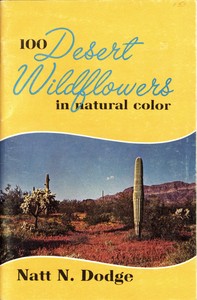
100 Desert Wildflowers in Natural Color — Key Ideas to Explore
(0 User reviews)
1014
Project Gutenberg
2017
Not confirmed
Wild flowers -- Southwestern States; Desert plants -- Southwest, New
Readers of public-domain and historical texts
Project Gutenberg digital edition
en
Edition facts
Words
16,687
Reading time
73 min
Text sections
4
100 Desert Wildflowers in Natural Color — Key Ideas to Explore can be approached with a clearer sense of reading commitment from its source measurements: 16,687 words, 1 hr 13 min estimated reading time, and 4 detected text sections.
The text analysis averages about 17.4 words per sentence, while the detected sections provide another way to judge how the source is divided.
Project Gutenberg metadata also associates the work with “Wild flowers -- Southwestern States,” connecting these edition facts with the source record’s subject description.
Source:
Project Gutenberg record #54631
Natt N. Dodge's 1963 field guide presents 100 desert wildflowers with color photographs and concise descriptions, emphasizing identification through bloom season, habitat, and distinctive features like spine structure or fruit persistence.
Editorial Edition Score
4.5/5
★★★★★
★★★★★
Calculated from edition completeness, EPUB availability, text structure and catalogue metadata. Not a user rating.
How this score is calculated
- Description quality20 pts
- Title & short description10 pts
- Source metadata20 pts
- Text length15 pts
- Chapters / structure15 pts
- EPUB file integrity20 pts
Total of 100 points, scaled to a 2.5-5.0 range. Editions with an empty description or a missing EPUB file are not scored.
Edition quality
Read the Text
nguages. The Spaniards added their names, and later the Americans added English names. Some of these names were of similar-appearing but quite different flowers they had known “back East.” Later, scientists studied the desert plants, and gave them all Latin names.
To assist in standardizing names of desert flowers, this booklet gives preference in its headings to scientific and common names found in _Arizona Flora_, by Kearney and Peebles, Second Edition, 1960. Common names found in _Texas Plants, A Checklist and Ecological Summary_, 1962, by F. W. Gould, also have been used. In addition, placed within the text, are some of the more widely used common names that we have encountered. Tree names, both common and scientific, follow the _Checklist of Native and Naturalized Trees of the United States_, by Elbert L. Little, Jr., 1953.
There are many desert flowers, some quite common, for which there was not space in this booklet. If you wish to broaden your acquaintance to include more, we recommend, for added reading publications listed in the back.
The author wishes to express here sincere thanks to Mrs. Pauline M. Patraw, Santa Fe botanist, for assistance in identifying many of the flowers pictured here. For assistance in checking identifications, the author is indebted to Miss Barbara Lund, Park Naturalist, National Park Service; to Dr. Charles T. Mason, Jr., Curator of the Herbarium, University of Arizona Tucson; and to Dr. W. B. McDougall, Curator of Botany, Museum of Northern Arizona, Flagstaff.
_Spring gives an Evening Party_
When Paloverde trims her golden gown, And Deerhorn dons her filaments of white; When tall Saguaro fits his fragrant crown In preparation for the party night; When bats across the ruby sunset dance, When Ocotillo lights his candle’s flame, When verdure carpets Desert’s wide expanse, Then Spring is in the Southwest once again.
The linnets in their scarlet vests and caps Are first to answer Spring’s insistent call, While white-crowned sparrows scan their travel maps, Discussing details of the coming ball. Then thrashers practice every morn and eve The songs they’ll sing upon that night of nights, While phainopeplas, in their haste to leave, Dash back and forth in short, impatient flights.
The desert halls glow bright as time draws near. Each cactus wears her frilled and perfumed dress. Ground squirrels, for this joyous time of year, Sport their best furs. The rabbits do no less. From far and near the desert folk have come To wait their hostess, Spring, who, very soon, Will lift stars o’er the skyline, one by one, And then turn on the glorious, golden moon.
Commonly called “Mormon tea,” there are many species of ephedra (ef-FED-rah) growing throughout the Southwest. This yellow-green, stringy-stemmed shrub with tiny, scale-like leaves, is usually 3 to 4 feet tall, but sometimes reaches a height of 12 feet. Its small, fragrant, springtime flowers grow in dense clusters that attract insects. Some species provide winter forage for cattle and are said to be browsed by bighorn sheep. Pioneers brewed a palatable drink from the dried stems. Certain Indian tribes considered the brew a tonic, beneficial for treatment of syphilis and other diseases. The drug, ephedrine, comes from a Chinese member of this genus.
_Ephedra trifurca_ Jointfir Family
Somewhat resembling bamboo, carrizo grows in dense thickets in marshes, along river banks, and in other wet locations. Largest of the grasses, it sometimes attains a height of 12 feet. The large, tassel-like flower heads appear from July to October and create a spectacular mass display. The horizontal rootstalks interlock, crowding out other plants. A single rootstalk may extend 30 feet. The straight, hollow stems served Indians as arrowshafts, pipestems, and loom rods. Along the Mexican border the leaves are woven into mats and the long, sturdy stems are used as screens and in roofing native houses.
_Phragmites communis_ Grass Family
3. Prairie spiderwort
Because of its slender, drooping leaves, this delicate blue-to-violet, three-petaled flower might easily be mistaken for a lily. Plants grow from 8 to 18 inches high. A perennial, the spiderwort’s thick, succulent roots enable it to produce blossoms from April to September. Not abundant, it is usually found in moist locations in desert mountain ranges at elevations above 2,500 feet. Flowers form in clusters at the tip of a plant’s stem, and are pollenized by bumblebees that eat the pollen.
_Tradescantia occidentalis_ Spiderwort Family
Natt N. Dodge's 100 Desert Wildflowers in Natural Color opens with a practical orientation for the reader: a section titled "Hints for Flower Photographers" and an introduction that explains the desert environment and the conditions that trigger blooming. The book then proceeds directly to its core—100 individual entries, each combining a color photograph with a compact description. The entries are numbered sequentially, and the table of contents lists every species by common name and page number, making the guide easy to navigate in the field.
The excerpts show that Dodge's writing is precise and observation-driven. For example, the entry for Jumping Cholla notes that its "joints are extremely brittle and the barbed spines catch so easily" that they "appear to jump from the plant." Such concrete details, grounded in the plant's physical behavior, recur throughout the text. The author also consistently includes elevation ranges, flowering months, and notes on animal or human use, as when he mentions that Walkingstick Cholla's "persistent clusters of yellow fruits" remain through winter, giving the impression the cactus is still in bloom.
Structure and Navigation
The book is organized as a numbered list of 100 species, each entry occupying roughly a page. The table of contents lists every plant by common name, so a reader can quickly locate, say, "Jumping Cholla" or "Evening-primrose." Dodge does not group entries by family or habitat; instead, the sequence appears to follow a loose botanical order, beginning with ephedra and reeds, moving through yuccas and agaves, then cacti, and finally composites and other forbs. This arrangement means that related species—such as the several chollas (entries 57–60) or the evening-primroses (entries 22 and 61)—are placed near each other, facilitating comparison.
Each entry follows a consistent pattern: the common name, scientific name, family, and a paragraph or two of description. The descriptions are self-contained, so a reader can dip into any entry without needing to read previous ones. The index at the back provides both common and scientific names, further aiding lookup.
Dodge's Descriptive Method
Dodge's descriptions are economical and sensory. He often begins with a plant's growth form and habitat, then moves to distinctive features. For Pencil Cholla, he notes it is "so slender-stemmed and sprawling in growth habit that it is easily overlooked in a tangle of vegetation." He then highlights its "orange to scarlet fruits about the size and shape of olives" as "striking eye-catchers." This technique—first acknowledging the plant's inconspicuousness, then pointing to a key identifier—helps the reader learn what to look for.
He also frequently includes practical details: the fruits of Engelmann Pricklypear are "eaten by many birds and rodents, as well as by desert Indians"; the stems of dead Walkingstick Cholla "leave a hollow cylinder of attractive wooden meshes" used for making canes. These observations ground the plants in their ecological and cultural context without straying into anecdote.
Bloom Seasons and Elevation Clues
Throughout the excerpts, Dodge provides specific flowering months and elevation ranges, which are critical for field identification. For example, Whipple Cholla blooms "in June and July" and is found "above 3,500 feet," while Pencil Cholla flowers "in May and June" and grows "at elevations of 200 to 5,000 feet." The Evening-primrose entry notes it "bloom[s] early in the springtime" and that its flowers "open at night and begin to wilt, turning pink during the following day." These temporal and altitudinal details allow the reader to anticipate what might be in bloom during a given trip to the desert.
Dodge also indicates when a species is especially showy: Evening-primrose "during favorable years make a spectacular spring display, sometimes growing with goldpoppies and sandverbenas to produce a riot of color." Such remarks help the reader plan when and where to look for mass blooms.
Cactus Entries as a Case Study
The four cholla entries (57–60) illustrate Dodge's approach to closely related species. He distinguishes them by growth form ("stocky bush cactus" vs. "slender-stemmed and sprawling"), spine appearance ("silvery sheen" for Jumping Cholla), fruit characteristics ("orange to scarlet fruits" for Pencil Cholla, "persistent clusters of yellow fruits" for Walkingstick), and elevation (Whipple Cholla is "of the higher desert above 3,500 feet"). He also notes behavioral traits: Jumping Cholla's joints "appear to jump from the plant" because they catch so easily, while Walkingstick Cholla's dead stems are used for canes.
These entries show how the book can be used to differentiate similar plants in the field. A reader encountering a cholla can check the descriptions against the plant's height, spine color, fruit, and habitat to narrow down the species. The photographs (not reproduced in the excerpts) would presumably support this process.
Dodge's guide rewards a patient, observational approach. Rather than reading straight through, consider taking it on a desert walk and comparing each plant you see to the relevant entry. The consistent structure—common name, scientific name, family, then description—makes it easy to jump between entries. Pay special attention to the details of bloom time, elevation, and fruit, as these are often the most reliable clues for identification. The book's compact size and focused scope make it a practical companion for anyone exploring the deserts of the southwestern United States.
There’s something tender about a field guide from 1963—how it trusts you to notice the small, stubborn details, the spines and seasons. It reminds me of old naturalists’ patience, the way they’d wait. I sometimes feel that same quiet wonder when I open The Variation of Animals and Plants under Domestication — Volume 2 — Inside the Classic, where change is measured not in bloom but in generations. Both books seem to whisper: things become what they are slowly.
There are no reviews for this eBook.
There are no comments for this eBook.
Reader reflection
How did this book work for you?
Your answers remain private and are stored only in this browser.
Your progress
0
/
10
2
How did the book work for you overall?
3
How likely are you to recommend this book?
4
How much effort did this book require?
5
What did you appreciate most?
6
Did the book give you something worth debating?
7
How much did the book move you?
8
Would you read this book again?
9
What changed or sharpened your thinking?
10