1

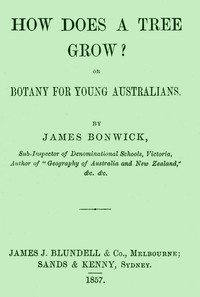
How Does a Tree Grow? Or, Botany for Young Australians — Background and Themes
(0 User reviews)
871
Project Gutenberg
2018
Not confirmed
Plants -- Australia -- Juvenile literature; Plant physiology -- Juvenile literature
Readers of public-domain and historical texts
Project Gutenberg digital edition
en
Edition facts
Words
13,322
Reading time
58 min
Text sections
4
The catalog record for How Does a Tree Grow? Or, Botany for Young Australians — Background and Themes provides practical reading context through 13,322 words, 58 min estimated reading time, and 4 detected text sections.
The text analysis averages about 16.4 words per sentence, while the detected sections provide another way to judge how the source is divided.
Project Gutenberg metadata also associates the work with “Plants -- Australia -- Juvenile literature,” connecting these edition facts with the source record’s subject description.
Source:
Project Gutenberg record #57142
James Bonwick's 1857 botany primer uses a father-son dialogue to explain plant physiology through Australian examples, blending colonial narrative with scientific instruction in a conversational voice.
Editorial Edition Score
4.4/5
★★★★★
★★★★★
Calculated from edition completeness, EPUB availability, text structure and catalogue metadata. Not a user rating.
How this score is calculated
- Description quality20 pts
- Title & short description10 pts
- Source metadata20 pts
- Text length15 pts
- Chapters / structure15 pts
- EPUB file integrity20 pts
Total of 100 points, scaled to a 2.5-5.0 range. Editions with an empty description or a missing EPUB file are not scored.
Edition quality
Read the Text
e was a fine rosy-faced boy of our southern colony. Though not eight years of age, he was as healthy and merry a lad as ever climbed up a Gum tree, picked up manna, or rode in a bullock dray.
His father had once occupied a good position in Old England; but the uncertainties and losses of business, and the constant struggle to uphold a respectable appearance with decreasing means, became so burdensome to his mind, that his spirits failed, and his energies sunk. His attention was directed to Australia, the land of mutton and corn, the home of health and plenty. Gathering up the wreck of the past, he left the country of taxation and paupers, and established himself on a small farm in Port Phillip.
The young hero of our story had been a year or two in the colony. It so happened he had a piece of land of his own, in which he proudly exhibited some rising cabbages, a few peas, and a flower or two. His father had given him a rose tree, which was the reigning beauty of the bed. It was upon the occasion of his parent’s visit to the garden, that the following dialogue took place:--
Look, father, and see how my rose tree has grown.
Indeed it has, Willie. Can you tell me what has made it grow?
The sun and the rain, I suppose.
Do you remember, when we got tired of the old slab hut, and set about building this brick cottage, that you noticed it getting higher and higher every day!
Yes, that was because more bricks and wood were used.
Then, if your tree increases in size, there surely must be something added on continually: do you think the sun and rain do this?
Well, I never thought about it, father; but I should like to know why it does grow.
Can you tell me, Willie, what a plum pudding is made of?
Yes, that I can. There is the flour, the suet, the raisins, and the cold water. All these are mixed together.
Then let us see of what our rose tree is made.
I don’t think it so easy to tell that as to reckon up the articles in a pudding.
Never mind, we will try. First, there is the stalk, or woody part. When you put a piece of stick in the fire, what becomes of it?
Oh, it smokes and blazes, and then nothing is left but some ashes.
What is it which burns away?
It is the gaseous part which burns in a flame, like what you have seen come out of coal. But what do you call woody matter that will not blaze?
Charcoal, father. Then I understand now that wood is nothing but charcoal and the gases. What are these gases?
The gas which blazes so readily, my dear, is hydrogen: and it has a very strong smell too. The air we breathe is a mixture of two gases--oxygen and nitrogen. It is only the oxygen that we take into our lungs.
Well, that is curious.
I shall puzzle you more, Willie, when I tell you that water is nothing but a mixture of oxygen gas and hydrogen gas.
It certainly is funny that water, which puts out flame, should be partly composed of the burning gas.
You must also know, my lad, that hydrogen would not burn without oxygen. You blow air into a fire to give food for flame.
But however could the plants get hold of the gases, father?
Did it never strike you why God formed leaves?
It never did, except that I thought he did it to make the trees look pretty.
That is quite true, Willie. The good God loves beauty, and he has surrounded us with beauty of all kinds. But he made things for use as well as to be looked at. The leaves absorb or suck in gases from air and water.
Then I suppose the veins like that we see in leaves conduct these gases away into the plant.
Quite right, my boy. Where now shall we get the charcoal, or carbon, as the learned men call it?
That I cannot find out at all.
You told me, Willie, that smoke came out of burning wood. What becomes of it?
When I was a very little boy, I thought it went up to form clouds; but now I know part of it turns into soot in the chimney, and that looks like our charcoal or carbon.
James Bonwick opens How Does a Tree Grow? not with a dry definition but with a story: eight-year-old Willie, a rosy-faced colonial boy who climbs gum trees and rides bullock drays, is about to learn why his rose tree grows. The book’s narrative frame—a father answering his son’s questions during a garden visit—is established in the first pages, and the scientific content emerges organically from Willie’s curiosity. Bonwick, a school inspector in Victoria, wrote this as part of a shilling series for colonial schools, and the text carries the rhythms of spoken instruction: short exchanges, leading questions, and patient explanations. The voice is warm but precise, and the setting—a small farm in Port Phillip—anchors the botany in a specific Australian landscape.
A Colonial Garden as Classroom
The dialogue begins with Willie’s pride in his garden—cabbages, peas, a rose tree—and his father’s gentle prompting: “Can you tell me what has made it grow?” Willie’s first guess (“the sun and the rain”) is met not with correction but with a comparison to building a brick cottage, where size increases because “more bricks and wood were used.” This analogy, drawn from the child’s own experience, sets the pattern for the whole book. Bonwick consistently translates abstract processes into concrete, domestic terms. When explaining how pollen reaches the pistil, the father lists “the wind blows the yellow dust. A bird throws some about. An insect catches some on its wings and legs.” The language is active, visual, and slightly playful—the pollen is “yellow dust,” the insect “steps on the stigma.” The colonial setting is never far away: Willie has “climbed up a Gum tree” and “picked up manna,” and the father’s own backstory—a failed English businessman who emigrated to “the land of mutton and corn”—gives the science lesson an undercurrent of settlement and adaptation.
Dialogue as a Teaching Tool
Bonwick’s preface explains his choice of the dialogue form: he believes “the sympathies of our young friends will be excited on behalf of the juvenile questioner, and their interest thus maintained.” The result is a text that moves at the pace of a real conversation, with Willie’s interjections (“Well, I never thought about it, father”; “That is singular”) keeping the exposition from becoming a lecture. The father rarely delivers a block of information without interruption; instead, he answers each question and then poses another, building knowledge step by step. For instance, when Willie asks about water plants, the father explains that some “rise to the surface to flower, and sink to seed,” while those that stay below have “a glutinous pollen, which cannot be affected with the wet.” The technical term glutinous is introduced naturally, as a solution to a problem Willie has just raised. This method gives the reader a model of inquiry: curiosity leads to observation, which leads to explanation, which leads to further curiosity.
From Ovules to Seeds: The Pace of Explanation
As the dialogue progresses, the pace quickens and the concepts become more intricate. Willie wants to “peep into the germen or ovary,” and the father obliges, describing ovules as “a sort of nucleus or kernel” placed between “two sacs of open mouths.” The language is vivid but careful: “Nothing goes in, but the pollen of the stamens comes down through them out upon the ovule, and is received to its Embryo, or heart, through a very small hole.” Bonwick uses italics for key terms (Ovules, Embryo) and parenthetical clarifications (“or heart”) to guide the reader without breaking the flow. The father emphasizes that the transformation from ovule to seed is not instantaneous: “Nourishment and time are necessary to growth and change.” This insistence on process—on the gradual, hidden work inside the seed—mirrors the book’s own method: slow, patient, and attentive to the unseen. The final surviving excerpt cuts off mid-explanation, but the pattern is clear: each answer opens a new question, and the dialogue never settles into a monologue.
Bonwick’s book is best read as a performance of scientific inquiry rather than a reference manual. The dialogue form rewards readers who follow the back-and-forth, noticing how the father turns Willie’s everyday observations into botanical principles. Because the excerpts are incomplete, the full arc of the lessons—from roots to flowers to seeds—remains partly hidden, but the method is consistent throughout. Readers interested in nineteenth-century educational writing, colonial Australian literature, or the history of science communication will find in these pages a lively example of how one author tried to make botany feel like a conversation.
The rain blurred the windows that afternoon, and Bonwick’s father-son talk of gum trees felt less like instruction than shared quiet. It made me long for that gentle voice again. Later, by lamplight, I found Plants and their children — A Reader’s Guide, which carried the same unhurried wonder, though its children were ferns and daisies. One book simply left me holding another.
There are no reviews for this eBook.
There are no comments for this eBook.
Reader reflection
How did this book work for you?
Your answers remain private and are stored only in this browser.
Your progress
0
/
10
2
How much did you enjoy the reading experience?
3
Would you recommend this book to another reader?
4
How much effort did this book require?
5
Was the book what you thought it would be?
6
Would you read this book again?
7
How closely did the book connect with your experience?
8
Could you apply anything you learned?
9
In one sentence, what did you learn?
10