1

Flowers, Shown to the Children — Key Ideas to Explore
(0 User reviews)
687
Project Gutenberg
2012
Not confirmed
Plants -- Juvenile literature
Readers of public-domain and historical texts
Project Gutenberg digital edition
en
Edition facts
Words
38,834
Reading time
169 min
Text sections
8
The source record for Flowers, Shown to the Children — Key Ideas to Explore measures this digital text at 38,834 words, 2 hr 49 min estimated reading time, and 8 detected text sections.
The text analysis averages about 15.1 words per sentence, while the detected sections provide another way to judge how the source is divided.
Project Gutenberg metadata also associates the work with “Plants -- Juvenile literature,” connecting these edition facts with the source record’s subject description.
Source:
Project Gutenberg record #40040
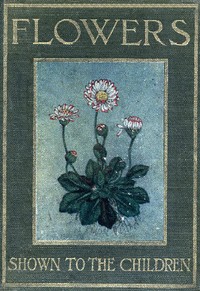
A children's flower guide organized by color, with detailed botanical descriptions and 48 color plates by Janet Harvey Kelman. The preface explains the color-grouping system, and entries like Common Eyebright and White Dead Nettle show precise floral anatomy.
Editorial Edition Score
4.7/5
★★★★★
★★★★★
Calculated from edition completeness, EPUB availability, text structure and catalogue metadata. Not a user rating.
How this score is calculated
- Description quality20 pts
- Title & short description10 pts
- Source metadata20 pts
- Text length15 pts
- Chapters / structure15 pts
- EPUB file integrity20 pts
Total of 100 points, scaled to a 2.5-5.0 range. Editions with an empty description or a missing EPUB file are not scored.
Edition quality
Read the Text
THE 'SHOWN TO THE CHILDREN' SERIES
Edited by Louey Chisholm
THE 'SHOWN TO THE CHILDREN' SERIES
With 48 Coloured Plates by Percy J. Billinghurst. Letterpress by Lena Dalkeith.
With 48 Coloured Plates, showing 150 flowers, by Janet Harvey Kelman. Letterpress by C. E. Smith.
With 48 Coloured Plates by M. K. C. Scott. Letterpress by J. A. Henderson.
PLATE I: 1. LESSER CELANDINE 2. BULBOUS BUTTERCUP 3. MEADOW BUTTERCUP 4. MARSH MARIGOLD
FLOWERS SHOWN TO THE CHILDREN
by JANET HARVEY KELMAN
DESCRIBED BY C. E. SMITH
FORTY-EIGHT COLOURED PICTURES
Dear Children,--If you were old enough to go to the bookseller and ask for a book that would tell you about the flowers you see growing in the woods and fields in spring and summer-time, you would find there were already a great many books which had been written with that purpose.
If you examined a few of these books, you would discover that in many the pictures of the flowers were not coloured, and that in these books the flowers were very difficult to recognise. And I think you would at once tell the bookseller you wished a flower-book with coloured pictures, where the flowers looked like real flowers.
Then you would examine more books, some of which have beautiful coloured pictures showing every flower that grows in our country. These books are very large and cost a great deal of money. You would see, too, quite small books which said they could tell about the common flowers we find in our country walks. And I think you would buy one of these.
But next day, suppose you were to find a bright blue flower growing in the field, and wished very much to know what it was called. You would open the flower-book and begin to look at the pictures, and there you would discover that the first picture showed a yellow flower, the next a red, the third a purple, a white or a blue, and you might have to turn over all the pages in the book before you found the flower you sought.
After you had looked at the picture of your blue flower, I think you would wish to know something more about the flower, and would like to read the writing to find out what it said.
But I am afraid you would not be able to understand what the flower-book told. There would be such long words telling about things you had never heard of, and you would begin to wonder if only older people could find out what books had to say about flowers.
Now this new flower-book is written just for the purpose of telling little children about the flowers. And in order to make it easy, the blue flowers have all been put together in one part of the book, the yellow in another, and the white in a third group; so you can at once know in what part of the book you will see a picture of any flower you find.
And I have made the writing which tells about each flower very easy, with as few new words as possible, so I hope you will be able to read it yourself, and find out how many wonderful and beautiful things there are in the flower-world which you might not notice unless you were told what to look for.
There are four new words you must learn to understand before you begin to read this book.
The first word is CALYX, and it means a covering. When the flowers are still babies, or buds, as they are called in flowerland, they are so soft and tender that too much rain, or a cold wind or a night of frost would do them harm. So nearly every flower has been given a warm covering which is folded closely round the tiny bud to protect it. Sometimes this calyx, or covering, is all in one piece like a cup, and the bud sits safely inside. But very often it is made up of five or six or more pieces, and when this is the case, these separate pieces are called sepals.
These SEPALS are very often green, like leaves, but you may have white sepals, or yellow sepals, or blue sepals or pink sepals. You will learn all about them after you know all that is in this flower-book and are able to read a more difficult one.
The preface of Flowers, Shown to the Children directly addresses a young reader's frustration: flower books either lack colored pictures or are too large and expensive, and even small ones arrange flowers by arbitrary order, forcing a child to flip through all pages to find a blue bloom. The solution offered is a book grouped by color—blue flowers together, yellow in another section, white in a third—so a child can turn immediately to the right part. This practical design choice shapes the entire work, making it a field guide built for a child's immediate use rather than a systematic botanical textbook.
A Preface That Frames the Book's Purpose
The opening pages function as a miniature manifesto for accessible natural history. The imagined child goes to a bookseller, rejects monochrome illustrations, finds large color-plate books too costly, and then discovers that small guides are hard to navigate. The author promises that this book solves both problems: it has colored pictures and a color-based arrangement. The preface also warns that other books use “such long words” that a child “would not be able to understand.” In response, the descriptions here are deliberately simple, avoiding technical jargon where possible. For instance, the Eyebright entry explains that “the petals are joined together into a tube, with two lips at the mouth” without naming the corolla or labiate structure. The preface thus sets expectations for a text that prioritizes clarity and direct observation over botanical terminology.
Anatomical Detail Within a Simple Framework
Despite the child-friendly tone, the entries contain precise morphological descriptions. The White Dead Nettle is described with “flowers grow in beautiful whorls or circles round the stem,” each whorl holding “as many as eighteen flowers.” The text notes the calyx “edged with five very long, sharp teeth” and the corolla tube with an upper hood and a lower fringed tongue. Similarly, the Spotted Orchis entry details “the broad petal, which folds back like a hanging lip” and “a long lilac spur” behind it. These observations are not merely decorative; they teach the reader to look for specific structures—stamens, seed-vessels, sepals—without overwhelming them. The language remains concrete: “the leaves are stained with purplish-black blotches” and “the stem varies much in height.” The result is a guide that trains the eye to notice botanical features while keeping the prose accessible.
Color Grouping as a Navigational Strategy
The catalog subject lists this as “Plants -- Juvenile literature,” but the excerpts reveal a distinctive organizational logic. The preface explicitly states that “the blue flowers have all been put together in one part of the book, the yellow in another, and the white in a third group.” This is not a taxonomic arrangement by family or genus but a practical one based on the most visible trait—flower color. The plates reinforce this: Plate I shows Lesser Celandine, Bulbous Buttercup, Meadow Buttercup, and Marsh Marigold—all yellow. Plate XXVI groups Common Eyebright (white/lilac), White Dead Nettle (white), and Spotted Orchis (pale lilac). The color grouping means a child who finds a white flower can flip to the white section and compare pictures. The text supports this by describing each flower’s color precisely, as with Eyebright’s “white, or pale lilac streaked with pink.” This system makes the book a tool for identification first, botanical education second.
The color-grouping system and the preface’s direct address to a child buyer reveal that this book was designed as a practical identification aid, not a comprehensive flora. Readers should note that the excerpts cover only a few entries; the full work includes 48 plates showing 150 flowers. The descriptions reward careful reading for their blend of simplicity and precision, and the color plates—though not reproduced in this digital edition—are integral to the book’s purpose. Approach the text as a historical artifact of children’s nature study, where the goal is to make the natural world recognizable and nameable.
Sometimes I think back to Flowers, Shown to the Children, how gently it introduced me to the quiet precision of petals and stems, and that memory surfaces whenever I open A practical course in botany — Context and Discussion. The first felt like a soft invitation; the other, a patient conversation with the same green world, offering a deeper handhold without leaving the wonder behind.
There are no reviews for this eBook.
There are no comments for this eBook.
Reader reflection
What was your reading experience?
Capture what you thought, learned, and would like to remember.
Your progress
0
/
10
2
What was your overall reaction to the book?
3
Would you encourage someone else to read it?
4
How much effort did this book require?
5
Would you like to discuss this book with someone?
6
Did the book meet your expectations?
7
What was its emotional impact?
8
Is this a title worth rereading?
9
What did this book teach you most?
10