
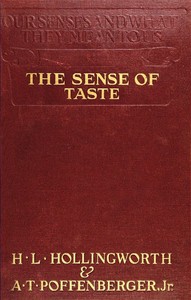
The Sense of Taste by Harry L. Hollingworth and Albert T. Poffenberger
Published in 1917, The Sense of Taste is a fascinating snapshot of early experimental psychology. Authors Harry Hollingworth and Albert Poffenberger weren't writing for foodies; they were scientists trying to measure the unmeasurable: how flavor influences the human mind.
The Story
There's no traditional plot here. Instead, the 'story' is the experiment. The researchers designed a series of rigorous tests where participants lived under controlled conditions. Their diet was reduced to a basic, tasteless base. Then, carefully and separately, elements like sucrose (sweetness), citric acid (sourness), salt, and caffeine were added. After consuming these altered meals, the subjects would perform standardized tasks—checking lists for errors, doing multiplication problems, tapping a key rapidly—while the scientists recorded their speed, accuracy, and reported moods. The book walks us through each experiment, the data collected, and the conclusions drawn about how even a tiny bit of sweetness might boost attention, or how bitterness could cause a subtle drag on performance.
Why You Should Read It
What grabbed me was the sheer curiosity of it all. This isn't dry data; it's the record of a hands-on quest to understand a piece of everyday magic. You get a real sense of the 'Aha!' moments, like when they realized taste perception isn't static—it changes with hunger or fatigue. Reading their careful notes from a century ago, you see the foundations of modern sensory science being laid. It makes you appreciate how much work went into proving something that seems obvious now: what we taste directly affects how we think and feel.
Final Verdict
This book is perfect for anyone interested in the history of science, psychology, or food culture. It's a short, focused read that offers a big payoff in perspective. You'll never look at a pinch of salt or a spoonful of sugar the same way again. It's not a beach read, but for a curious mind, it's a compelling and rewarding look into the lab where our understanding of taste began.
This book is widely considered to be in the public domain. You can copy, modify, and distribute it freely.
Mary Martin
6 months agoHaving followed this topic for years, I can say that it manages to maintain a consistent flow even when discussing difficult topics. I'm glad I chose this over the other alternatives.
Ashley Davis
5 months agoAs a long-time follower of this subject matter, the breakdown of complex theories into digestible segments is masterfully done. It’s hard to find this much value in a single source these days.
Kimberly Anderson
10 months agoWhile browsing through various academic sources, the way the author breaks down the core concepts is remarkably clear. The price-to-value ratio here is simply unbeatable.
Mary Rodriguez
11 months agoSolid information without the usual fluff.





Linda Jones
11 months agoIt’s refreshing to see such a high standard of digital publishing.