
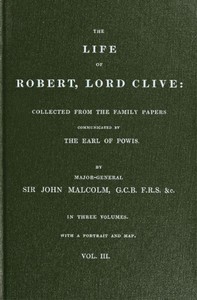
The Life of Robert, Lord Clive, Vol. 3 (of 3) by John Malcolm
This third volume picks up right after Clive's greatest professional triumphs in India. He returns to Britain in 1760, not as a young adventurer, but as a national hero with immense wealth and the title 'Lord Clive of Plassey.' But home isn't a peaceful reward. The book follows his complex life over the next decade and a half, which is a wild ride of political warfare, public scandal, and personal struggle.
The Story
Malcolm shows us Clive trying to navigate British politics. He gets a seat in Parliament and uses his influence to defend the East India Company's interests. But his enemies are everywhere. Rival politicians and jealous former colleagues launch investigations into his conduct and fortune. They accuse him of corruption and abuse of power back in India. The bulk of the narrative is this tense, drawn-out conflict. Clive fights to clear his name, giving famous, fiery speeches in his own defense. He even goes back to India one last time in 1765 to try and fix the administrative mess there, proving he's still the only man who can manage the empire he helped create. The story builds towards his tragic and controversial end, leaving you to wrestle with what it all meant.
Why You Should Read It
This volume is fascinating because it completely upends the 'conqueror' narrative. We see the human cost of empire-building on the builder himself. Clive is portrayed not as a cartoon villain or a flawless hero, but as a brilliant, arrogant, deeply stressed man trapped by his own creation. Malcolm, who knew India firsthand, doesn't shy away from Clive's flaws or the moral gray areas of his actions. The real tension isn't in sword fights; it's in parliamentary debates and private letters. You're watching a man's legacy be fought over while he's still alive. It makes you think hard about fame, power, and how history judges its 'great men.'
Final Verdict
This isn't a light introduction. It's perfect for history buffs who already know the basics of Clive's rise and want the deep, dramatic conclusion. If you enjoy biographies that explore the dark side of success and the messy aftermath of war, you'll be hooked. It's also great for anyone interested in the early days of British politics and corporate power (the East India Company was basically a mega-corporation running a country!). Fair warning: it's a detailed, old-school biography, so come ready for a deep dive. But for the right reader, it's an absolutely gripping portrait of a giant falling.
There are no legal restrictions on this material. Knowledge should be free and accessible.
Karen Jackson
3 months agoI've been looking for a reliable source on this topic, and the data points used to support the main thesis are quite robust. A rare gem in a sea of mediocre content.
Karen Johnson
4 months agoGiven the current trends in this field, the concise summaries at the end of each section are a lifesaver. Highly recommended for those seeking credible information.
Sarah Martinez
4 weeks agoThe layout is perfect for tablet and e-reader devices.
Mary Johnson
4 months agoI started reading this with a critical mind, the chapter on advanced strategies offers insights I haven't seen elsewhere. I’ll definitely be revisiting some of these chapters again soon.






Elizabeth Moore
1 year agoI appreciate the objective tone and the evidence-based approach.