
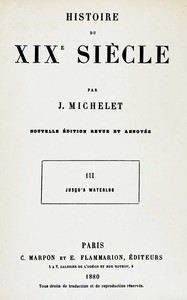
Histoire du XIXe siècle (volume 3/3) : III. Jusqu'à Waterloo by Jules Michelet
Jules Michelet's third and final volume picks up the thread of a Europe utterly transformed by the French Revolution and now dominated by the figure of Napoleon Bonaparte. The book charts the escalating conflict as Napoleon's empire expands, triggering coalitions of European monarchies determined to stop him. Michelet guides us through the major military campaigns, the political maneuvering, and the growing war-weariness across the continent, building inevitably toward the famous showdown in Belgium.
The Story
This isn't a simple chronicle of troop movements. Michelet frames the Napoleonic Wars as the last, grand act of the revolutionary drama that began in 1789. He shows us Napoleon not just as a general, but as a force who both spread and ultimately betrayed the revolutionary ideals of liberty. The story follows the tightening noose around the French Empire—the disastrous invasion of Russia, the battles in Germany, and the eventual invasion of France itself. The narrative culminates in the Hundred Days, Napoleon's dramatic return from exile, and the final, decisive confrontation at Waterloo. Michelet treats this battle as a world-historical pivot point, the moment the old order finally managed to contain the revolutionary spirit, at least for a time.
Why You Should Read It
You should read this because Michelet makes history feel alive and urgent. He has a point of view. He's cheering for the spirit of the people and mourning what he sees as Napoleon's tragic turn toward despotism. His writing is full of vivid scenes and sharp judgments. You get the sense of immense forces—nationalism, liberty, reaction—colliding on the battlefield. It's history told with the heart of a novelist and the insight of a philosopher. You come away understanding Waterloo not just as a military loss, but as a profound symbolic end to an era of wild hope and upheaval.
Final Verdict
This book is perfect for readers who found history class boring and want to be proved wrong. It's for anyone who enjoys epic narratives with high stakes and complex characters, even if those characters are real historical figures. You don't need to be a scholar; you just need curiosity about how our modern world was shaped. If you like your history with passion, drama, and a strong authorial voice, Michelet's final volume is a thrilling and thought-provoking ride. Just be ready—it might ruin bland textbooks for you forever.
This is a copyright-free edition. Distribute this work to help spread literacy.


Margaret Thompson
5 months agoThe balance between academic rigor and readability is perfect.