
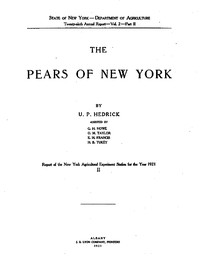
The pears of New York by U. P. Hedrick
Let's be clear from the start: 'The Pears of New York' is not a storybook. Published in 1905 by the New York State Department of Agriculture, it's a technical report. U.P. Hedrick, a pioneering horticulturist, was given a simple but huge task: make a complete record of every pear variety being grown across the state.
The Story
There's no plot with characters, but there is a clear narrative drive. Hedrick traveled, collected, tasted, and documented. The book is his findings. He lays out the history of pear-growing in New York, then gets to the heart of it: detailed profiles of hundreds of varieties. For each one, he describes the tree, the leaf, and the fruit with scientific precision—its size, shape, color, and texture. But then he goes further. He tells you how it tastes, its best uses, and its history. Where did it come from? Who bred it? Why was it loved? He's not just listing fruit; he's writing biographies for apples. The underlying tension is the reason for the book: he saw a wave of standardization coming. As commercial orchards focused on a handful of varieties that shipped well, he knew these unique, often locally cherished pears would disappear. This book was meant to be their permanent record.
Why You Should Read It
You should read it because it changes how you see the world. After a few pages, you'll never look at a supermarket fruit aisle the same way. Hedrick's passion is contagious. His descriptions are so specific and sensory—writing about the 'rich, buttery flesh' of one pear or the 'sprightly, vinous flavor' of another—that you start to mourn flavors you've never tasted. It connects you to a time when food was deeply local and diverse. It's also surprisingly human. In between the data, you find little judgments (he clearly had favorites) and concerns about farming trends that feel incredibly modern. It’s a quiet, profound lesson in paying attention, in valuing what's unique before it's gone.
Final Verdict
This is a niche book, but its appeal is wider than you'd think. It's perfect for foodies, gardeners, and local history lovers who enjoy primary sources. If you like the idea of 'Slow Food' or heirloom vegetables, this is your foundational text. It's also great for anyone who finds beauty in old, specialized knowledge—the kind of person who reads old field guides for fun. Don't read it cover-to-cover; dip in and out. Let yourself be amazed by the sheer variety our landscapes once held. It's a preserved slice of American agricultural life, and a powerful reminder that progress often means leaving delicious things behind.
This text is dedicated to the public domain. You can copy, modify, and distribute it freely.
Emily Anderson
2 years agoThe author provides a very nuanced critique of current methodologies.
Susan Williams
1 month agoWhile browsing through various academic sources, the attention to detail regarding the core terminology is flawless. This is a solid reference for both beginners and experts.
Karen Harris
10 months agoHaving explored several resources on this, I find that the level of detail in the second half of the book is truly impressive. I feel much more confident in my knowledge after finishing this.
Christopher Harris
3 months agoExtremely helpful for my current research project.








Sarah Anderson
1 year agoComparing this to other titles in the same genre, the author doesn't just scratch the surface but goes into meaningful detail. I appreciate the effort that went into this curation.